
Remote software developer jobs at U.S. companies
We, at Turing, are looking for talented remote software developers who can build high-quality, innovative, and fully performing software that complies with coding standards and technical design.
Find remote software jobs with hundreds of Turing clients
Job description
Job responsibilities
- Test software development methodology in an agile environment & provide inputs for continuous improvement
- Provide ongoing maintenance, support, and enhancements in existing systems and platforms
- Comply with project plans and industry standards to troubleshoot, debug and upgrade systems
- Automate various processes, build software infrastructure, aid in capacity planning and architecture
- Work with data scientists, business users, project managers & other engineers to build the required software solutions
Minimum requirements
- Bachelor’s/Master’s degree in Computer Science (or equivalent experience)
- 3+ years of software development experience building (exceptions based on skill level)
- Experience supporting production quality software and owning projects from end-to-end
- Experience with test-driven development and automated testing frameworks
- Capable of delivering on multiple competing priorities with little supervision
- Execute the full software development life cycle & build highly available, scalable & secure systems
- Skilled in various web technologies & their nuances like HTML, CSS, UI/UX, React, Angular, and design among others
- Knowledge of coding languages, such as C++, Java, JavaScript, and code versioning tools like Git
- Communicate fluently in English with engineering managers at U.S. software companies
- The ability to work full-time (40 hours/week) and a 4 hour overlap with U.S. time zones
Preferred skills
- Experience with Scrum/Agile development methodologies
- Experience with databases and Object-Relational Mapping (ORM) frameworks
- Experience building large-scale, customer-centric software applications
- Strong understanding of large codebases, like API techniques & handling large volumes of data
- The ability to use constructive feedback to continuously grow and improve
Interested in this job?
Apply to Turing today.
Why join Turing?

1Elite US Jobs
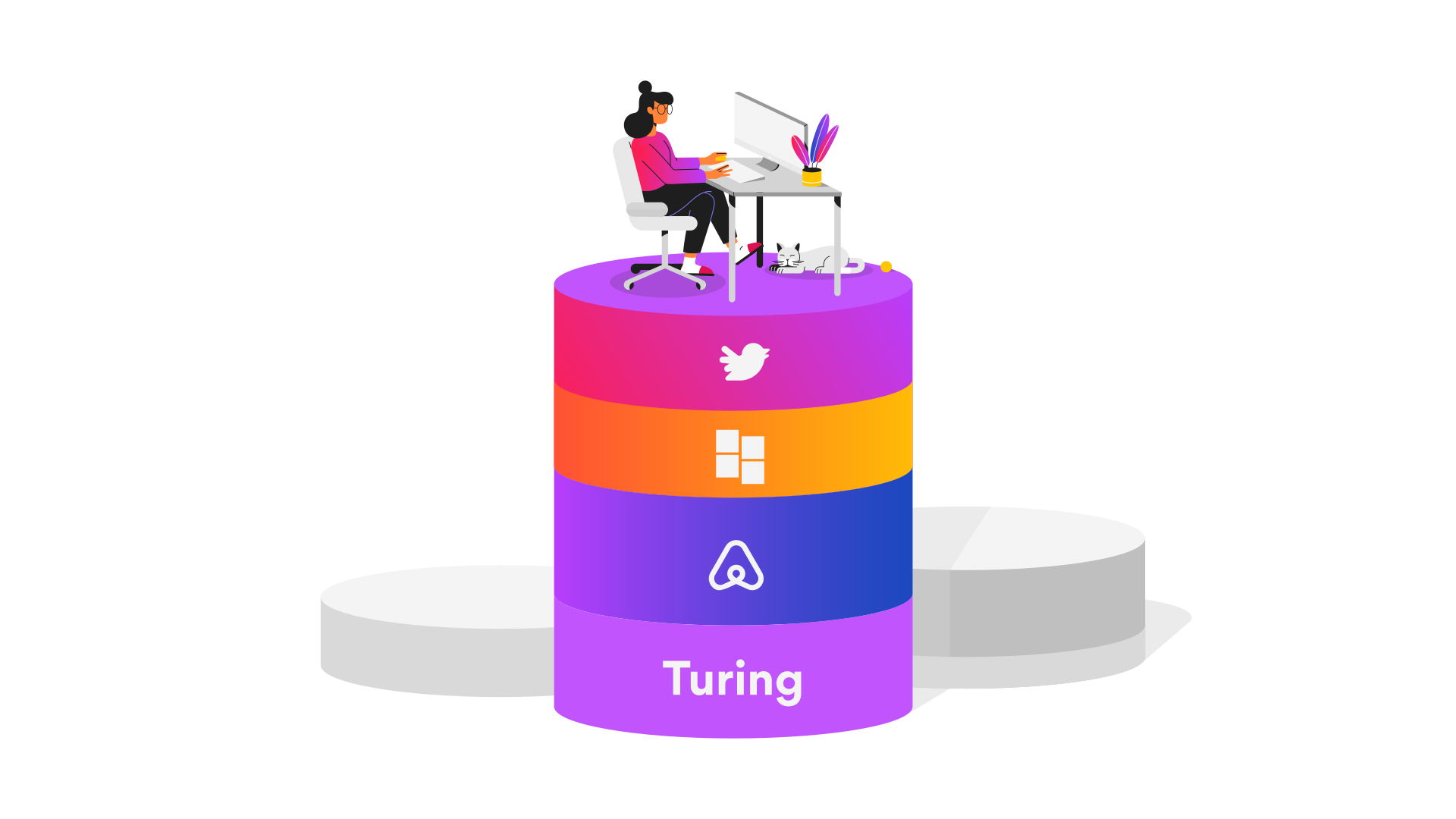
2Career Growth

3Developer success support







How to become a Turing developer?
Create your profile
Fill in your basic details - Name, location, skills, salary, & experience.
Take our tests and interviews
Solve questions and appear for technical interview.
Receive job offers
Get matched with the best US and Silicon Valley companies.
Start working on your dream job
Once you join Turing, you’ll never have to apply for another job.

How to become a software developer?
Software development is the process through which programmers create computer programs. The process, commonly known as the Software Development Life Cycle (SDLC), consists of many phases that give a mechanism for developing products that fulfill technical standards as well as user needs.
The SDLC offers an international standard for software firms to utilize while developing and improving computer systems. It provides a specified structure for development teams to follow while designing, developing, and maintaining high-quality software. The goal of the IT software development process is to provide high-quality solutions within a set budget and schedule.
What is the scope of software development?
Being a software developer opens a number of career opportunities for you.
According to current trends, new technologies such as artificial intelligence, automation, virtual reality, and cryptocurrencies will trigger the urgent demand for employment in engineering, product development, data science, marketing, and sales. With each passing second, more and more conventional businesses are beginning to impose and embrace high-end technology, much like any successful IT firm in the market, be it health care or finance, since it simplifies workflow and reaps sweet benefits and returns. The potential software developer jobs are in the areas of:
Data Scientist
The specialists acquire, analyze, and display data using statistics and software engineering skills to obtain valuable insights that, when included in decision making, can increase the organization's yield and individual returns. Few people realize that machine learning is a subset of the data science department that is used to generate predictions about trends based on data retrieved in the past, evaluate the accuracy of the forecasts, and then refine the algorithms to improve the process of future predictions.
Cybersecurity Engineer
Companies are constantly in the search for smart software engineers that can provide a stronger and more active layer of security without sacrificing quality.
Machine learning engineer
Analyzing online search results, real-time advertisements on devices, email spam filtering, and pattern and picture recognition may all provide important data to machine learning engineers. Such thorough procedures eliminate the previous methods of data analysis (which are based mostly on trial and error) – Machine learning puts a halt to the chaotic data process by building quick, efficient algorithms and real-time data models to offer accurate targets and analysis.
Full-stack developer
Rather than having distinct back-end and front-end teams allocated to it, full-stack developers handle the whole project, from idea design through product deployment.
The front-end layer is largely concerned with the client's experience and subsequent user reaction, whereas the back-end is concerned with the logic of the web app. The server side of the program includes everything from creating the appropriate back-end languages to guaranteeing a relevant thesis. Finally, database development and upkeep.
What are the roles and responsibilities of a software developer?
You might work as a software developer in a number of sectors, which means you could work on a variety of projects. You will most likely collaborate closely with engineers, product managers, graphic designers, and business analysts to determine what clients want and the most efficient method to deliver it. You will be in charge of either replacing an entire system or updating software and integrating it into existing networks. Your daily tasks may include: Using a variety of programming tools and languages, your everyday activities may include:
- Software research, design, implementation, and management
- New programmes are being tested and evaluated.
- Identifying areas for improvement in current programmes and then implementing these improvements
- Writing and deploying effective code
- Creating processes for quality assurance
- Putting software tools, procedures, and measurements in place
- Existing systems must be maintained and upgraded.
- User education
- Collaborating with other developers, UX designers, business analysts, and systems analysts
- Assessing operational feasibility
How to become a software developer?
Several students select a bachelor's degree in computer science because it allows them to study in-depth theoretical ideas of computer science courses, which helps them grasp the principles of software development. Data structures, algorithms, web technology, computer networks, Mathematics, database systems, programming languages, and a variety of other important courses assist students gain a thorough grasp of software engineering and current software development techniques.
Many businesses establish the qualifying criteria for a four-year bachelor's degree programme in computer science, so getting a degree is a good option, but you shouldn't rely solely on a degree. All of those topics will not provide you with practical experience or allow you to work on real-world projects. You cannot tell someone that you have enrolled in a course to become a software engineer unless you have had practical experience.
To become a software developer, you must put your theoretical knowledge and principles into practise by working on real-world software. You must demonstrate your practical abilities to the recruiter, and we will discuss what you should do in addition to theoretical knowledge in the following sections.
Language is how humans interact with one another, and you must tell your computer what to do in a language that computers can comprehend. Even if you are a graduate or have a degree, it is useless if you do not have a thorough grasp of any programming language used to create software. You must now assume responsibility for your own education, so select a programming language based on your preferences and goals, and become well-versed in it.
Some languages to consider include Ruby, Java, Python, C++, C#, and Javascript. As a starter, it is not necessary to learn three or four languages at the same time. Begin with one language and become fluent in it. Once you've gained some experience, you can try your hand at another language.
Interested in remote software developer jobs?
Become a Turing developer!
Skills required to become a software developer
We will discuss some important technical skills you should have as a developer or if you are planning to become a good developer and land a good Software developer job:
1. Data Structures and algorithms
Most organisations place a high value on this ability when evaluating problem-solving and coding abilities. You may become a good software developer if you understand how data can be structured and used to address real-world problems. As a developer, a student of computer science, or a self-taught programmer, you should make a concerted effort to understand data structures and algorithms (e.g. array, linked list, tree). The essence of programming is data structures and algorithms. Most developers do not recognise its significance at first, but when you begin your career in software development, you will notice that your code is taking too long.
2. Programming languages
To be a skilled programmer, you must be fluent in at least one programming language. When selecting the programming language to use, consider your area of interest and the language in which you like to solve issues or are most comfortable.
3. Source control
Source control aids developers in the management and storage of their code. Today, the majority of organisations are seeking for a developer that is skilled in version control and can work with other team members. So, if you want to be a competent software engineer, you need to be familiar with version control principles and technologies such as Git (favoured by 70-80% of organisations), Mercurial, SVN, and so on.
4. Integrated Development Environments (IDEs)
IDEs allow you to write, change, build, run, and debug code. Varied programmers have different options when it comes to selecting the ideal development environment for the goal or language they are working on. Every programmer should be able to utilise an IDE to write, build, execute, and debug code. Using an IDE speeds up their job, and there are several IDEs available for developers to choose from.
5. Databases
Understanding how to interact with databases is a necessary ability for developers. Developers should be able to do all types of operations, such as creating, inserting, updating, and deleting records. Without a database, no company can create any sort of application or software. When a developer works on a significant business project, they must also take care of security issues and manage the entire organization's records with adequate backup, which is why every organisation expects a developer who is comfortable dealing with databases and maintaining the entire records securely. SQL is without a doubt the most popular traditional database among developers. If you want to be a successful developer, you should be able to write at least basic SQL queries.
6. Collaboration and communication are essential
Being programmatic might look isolated at times, but it is actually quite the contrary. During a development sprint, software developers frequently discuss progress, cooperate on projects, and supervise others. Any problems with teamwork or communication might jeopardise a project or meet a deadline.
7. Multitasking
One of the most important talents necessary to become a software engineer is the ability to multitask. Software engineers operate in deadline-driven sprints, which frequently require them to work on numerous projects at the same time. Software developers must grasp the principles of prioritising and time management in order to multitask well.
Interested in remote software developer jobs?
Become a Turing developer!
How to get remote software developer jobs?
Turing provides the greatest remote software development jobs to complement your career as a competent software developer. Working on tough new technology and business issues can help you grow quickly. Join our network of the world's top developers to get long-term, full-time remote software development jobs with better pay and opportunities for advancement.
Why become a Software developer at Turing?

Elite U.S. jobs
Long-term opportunities to work for amazing, mission-driven U.S. companies with great compensation.

Career growth
Work on challenging technical and business problems using cutting-edge technology to accelerate your career growth.

Exclusive developer community
Join a worldwide community of elite software developers.

Once you join Turing, you’ll never have to apply for another job.
Turing's commitments are long-term and full-time. As one project draws to a close, our team gets to work identifying the next one for you in a matter of weeks.

Work from the comfort of your home
Turing allows you to work according to your convenience. We have flexible working hours and you can work for top U.S. firms from the comfort of your home.

Great compensation
Working with top U.S. corporations, Turing developers make more than the standard market pay in most nations.
How much does Turing pay their software developers?
Every software developer at Turing has the ability to determine their own rate. However, Turing will propose a wage at which we are confident we can find you a successful and long-term opportunity. Our recommendations are based on our evaluation of market circumstances as well as client desire.
Frequently Asked Questions
Latest posts from Turing







Leadership
Equal Opportunity Policy
Explore remote developer jobs


Based on your skills
- React/Node
- React.js
- Node.js
- AWS
- JavaScript

- Python

- Python/React
- Typescript

- Java
- PostgreSQL

- React Native
- PHP
- PHP/Laravel

- Golang
- Ruby on Rails

- Angular
- Android

- iOS

- AI/ML

- Angular/Node
- Laravel
- MySQL

- ASP .NET

Based on your role
- Full-stack
- Back-end
- Front-end
- DevOps
- Mobile

- Data Engineer

- Business Analyst
- Data Scientist
- ML Scientist

- ML Engineer

Based on your career trajectory
- Software Engineer
- Software Developer
- Senior Engineer
- Software Architect
- Senior Architect
- Tech Lead Manager
- VP of Software Engineering