Turing

Turing.com review by ex-Facebook engineer

"The culture and experience at Turing is at par with Silicon Valley companies"

- Parv, ML Engineer from India

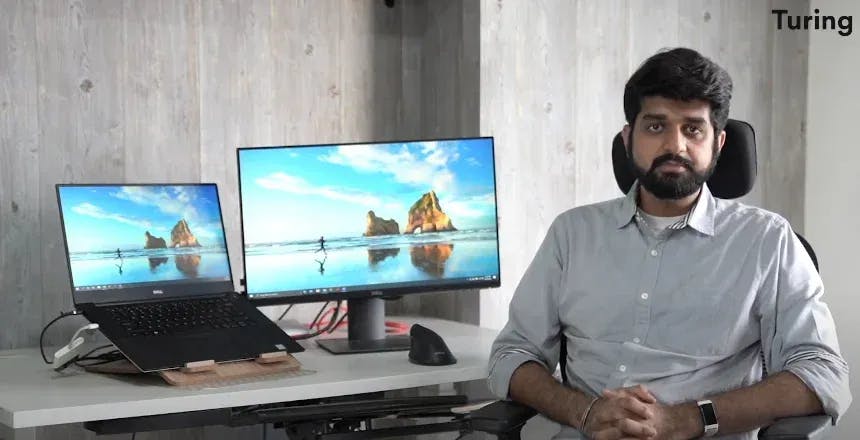
Parv sharing his Turing.com review

Parv, a former Facebook engineer, shared his Turing.com review in an exclusive interview with Turing Newsdesk and said that the company’s value proposition gave him access to the world’s best career opportunities. He also added that his role at Turing gave him an opportunity to interact with a diverse group of colleagues from around the world.

Life before Turing jobs

Parv is an ML engineer based out of Mumbai, India. Having studied computer science at the Georgia Institute of Technology, Parv has over eight years of experience in building platforms and production-ready machine learning and deep learning systems.

Parv’s exceptional knowledge and understanding of his subject helped him start his career with a bang. “I was with Facebook at their Silicon Valley and New York offices. I helped build a generic machine learning platform that every team uses across the company, and also worked on increasing users’ engagement with Ads,” he recalls.

“Then I moved to Instagram and created a system that would deliver a better user experience on the Hashtag pages by increasing the quality and relevancy of the images shown. I progressed rapidly from an engineer to a Tech Lead in the 5 years at Facebook.’’

After spending many years away, Parv decided to return home and spend more quality time with his family and friends. But having lived a fast life, he didn’t want to put the brakes on his career. “ I wanted to make sure that my rapid career growth continued at the same pace, despite moving out of Silicon Valley,” he says.

How did he learn about Turing US software jobs?

Being always on the lookout for relevant opportunities, Parv came across a Turing job ad on Facebook and wasted no time applying.

“Turing’s value proposition of giving me access to the world’s best career opportunities, no matter where I lived, was very compelling to me. In a few hours, I completed Turing’s tests and interviews related to Machine Learning and Data Science. Within two weeks, they offered me the position of Lead ML Engineer. I accepted,” he shares.

How has his journey with Turing.com been so far?

Since joining Turing, Parv has realised that you don't need to be away from your family to work with international industry leaders.

“Every day, I get to interact with a diverse group of colleagues from around the world and work together on products that are defining the future of work. It’s very exciting to build novel Machine Learning technologies to help solve the trillion-dollar problem of matching talent with opportunity at a global scale.”

What’s his take on Turing developers?

Being a Turing developer means you work with some of the best professionals in the world. “Working on challenging problems and collaborating with very talented colleagues from all over the world has contributed significantly to my continuous growth,’’ he mentions.

What's the final verdict?

“Having lived and worked in Silicon Valley, I can state firsthand that the culture and experience created at Turing is at par with the world’s best companies,” he concludes.

Interested in working with the best US companies while living anywhere in the world? Click here to go #Boundaryless with Turing.

Interested in U.S. software jobs?

Apply to Turing today.

Apply now

Explore remote developer jobs

briefcase
Principal AI Engineer - US NYC

Principal AI Engineer

Location: US(NYC)- 3(WFO)

Employment Type: Full Time (Overlapping EST)

Experience Level: Staff/Principal (8–14 years)


About the Role

Turing is hiring a Staff/Principal AI Engineer to lead enterprise-scale agentic AI implementations for Fortune 500 clients. This is a hands-on engineering role focused on designing and shipping autonomous, tool-calling AI systems — agents that reason over enterprise context, invoke real systems through secure interfaces, and operate reliably at scale under strict latency, cost, and governance constraints.

You will own these systems end to end: the data pipelines feeding them, the backend services around them, the agent orchestration layer, the evaluation harness that keeps them honest, and the cloud infrastructure they run on. We are looking for engineers with genuine software engineering and data science depth who have taken agentic systems all the way to production.

What We're Looking For

Engineering foundation

  • 8–14 years of software engineering experience, with strong hands-on large-scale Python
  • Working depth in at least one systems or backend language — Go, Rust, Java, or C/C++ — and the judgment to know when to reach for it
  • Strong data structures and algorithms.
  • Strong understanding of APIs, microservices, and system design
  • Hands-on experience building and operating data pipelines and production-grade distributed systems.

Agentic AI and LLMs

  • 2+ years of hands-on LLM engineering, with at least couple agentic system you designed and took to production
  • Production experience with agent frameworks — LangGraph, Google ADK, CrewAI, Claude Agent SDK, or equivalent — and the fluency to move between them as the ecosystem evolves
  • Experience building MCP (Model Context Protocol) servers and tool-calling interfaces
  • RAG from first principles: chunking strategy, embeddings, vector and hybrid retrieval, reranking, and response validation
  • Strong experience with vector databases (Milvus, Pinecone, Weaviate, FAISS, etc. or cloud equivalents)
  • Design of guardrails and reliability patterns — validators, policy checks, self-correction loops, deterministic fallbacks, circuit breakers, and rollback paths

Optimization

  • Deep familiarity with token optimization and context-window management — context shaping, pruning, and compaction
  • Latency and cost optimization through caching, model routing, batching, streaming, and parallel tool calls
  • Performance testing and tuning systems against defined SLOs

Evaluation

  • Experience building evaluation frameworks for LLM systems — offline eval sets, continuous online evaluation, and regression detection
  • Instrumentation and traceability suitable for regulated enterprise environments using tools like LangSmith, Langfuse, etc.

Cloud

  • Hands-on AWS: containerized services (ECS/EKS), serverless (Lambda), data services (S3, DynamoDB, Redshift) and orchestration (Step Functions); Azure or GCP equivalents also valued
  • Familiarity with CI/CD pipelines and DevOps practices
  • Infrastructure as code with Terraform or CloudFormation, and mature CI/CD practice

Working traits

  • Strong analytical problem-solving with a bias to ownership and urgency
  • Clear cross-team communication, working directly with client stakeholders to translate business problems into technical roadmaps
  • Able to work productively in ambiguity from system-level documentation and ramp quickly in unfamiliar codebases

Good to Have

  • Experience with managed AI platforms — Amazon Bedrock, Vertex AI, Azure AI — paired with fluency in the underlying fundamentals

Roles & Responsibilities

  • Design and build agentic systems: Lead the architecture and implementation of tool-calling agents that combine retrieval, structured reasoning, and secure action execution with least-privilege access.
  • Productionize LLM applications: Build retrieval pipelines, prompt synthesis, response validation, and self-correction loops, backed by rigorous evaluation.
  • Own the full stack: Deliver the data pipelines, backend services, distributed compute, and orchestration layer that agentic systems depend on — not only the model invocation.
  • Engineer for reliability and governance: Build validator models, adversarial test suites, and policy checks; enforce deterministic fallbacks and rollback strategies; instrument continuous evaluation.
  • Optimize for cost and latency: Drive measurable improvements in token efficiency, response time, and unit economics against defined SLOs.
  • Codebase ownership: Build, maintain, and review high-quality Python and SQL, with an emphasis on reusable components, scalability, and performance.
  • Cloud integration: Deploy AI applications on AWS, Azure, or GCP with optimized resource usage and robust CI/CD.
  • Cross-functional collaboration: Partner with product owners, data scientists, and business SMEs to define requirements and deliver impactful AI products.
  • Mentoring and technical leadership: Set engineering standards and share knowledge across the team, raising the bar on AI and software engineering practice.
Finance
10K+ employees
PythonGoRust+ 4
briefcase
Lead Edge AI & Computer Vision Engineer

Lead Edge AI & Computer Vision Engineer

  • Location: USA [with regular on-site travel required to client site]
  • Target Start Date: 1 Sep
  • Time Commitment: 8 weeks full-time
  • Experience Level: 12–15+ Years

Core Objective: Architect, benchmark, and optimize an end-to-end computer vision and low-latency execution pipeline—combining spatial geometric math with low-level C++/CUDA acceleration directly on NVIDIA Jetson embedded edge hardware (Orin NX / AGX Orin) to achieve sub-10 ms processing latency.

Key Responsibilities

  1. Model Selection & Spatial Math: Evaluate real-time detection topologies (e.g. YOLO) at 100+ FPS and build 2D perspective homography unwarping, lens undistortion, and spatial algorithms to convert pixel coordinates into physical millimeter units within tight error bounds (millimeter level accuracy).
  2. TensorRT INT8 Acceleration: Execute Post-Training Quantization to compile PyTorch/ONNX models into high-throughput TensorRT INT8/FP16 engines on Jetson Orin hardware without accuracy degradation.
  3. Zero-Copy Memory Architecture:  Engineer zero-copy memory pipelines using NVIDIA Memory Management and DMA transfers to eliminate bottlenecks.
  4. Compiled C++ Execution & I/O: Build compiled C++17 execution frameworks with multi-threaded lock-free ring buffers and non-blocking asynchronous socket communication.
  5. Nsight Profiling & Roadmapping: Instrument stage-by-stage pipeline latency using NVIDIA Nsight Systems/NVTX markers to bound tail latency, author feasibility reports, and design technical roadmaps.

Key Qualifications & Experience

  1. Full-Stack Edge AI Experience: 12–15+ years of experience bridging real-time computer vision algorithm design, spatial geometry, and low-level C++/CUDA execution on embedded edge hardware.
  2. NVIDIA Jetson Ecosystem: Deep expertise in Jetson embedded platforms (Orin NX, AGX Orin, L4T, power profiles, core pinning) and a proven track record compiling/tuning TensorRT FP16/INT8 engines via PTQ/QAT.
  3. Optical & Spatial Geometry: Expertise in 2D/3D camera calibration, perspective homography transformations, lens distortion modeling, and millimeter sizing math in industrial settings.
  4. Low-Latency Systems Engineering: Expertise in zero-copy shared memory, DMA frame buffers, lock-free queues, custom CUDA plugins, and microsecond profiling via Nsight Systems and NVTX markers.
  5. Tooling & Industrial I/O: Proficiency in C++17, Python, PyTorch, OpenCV, CUDA, non-blocking asynchronous sockets (UDP, PLC integration), and building automated dataset benchmarking harnesses.
Manufacturing
10K+ employees
C++CUDANVIDIA Omniverse+ 5
sample card

Apply for the best jobs

View more openings

Work full-time at top U.S. companies

Create your profile, pass Turing Tests and get job offers as early as 2 weeks.