

Data Collection Methods, Sources, and Tools for LLM Training: A Complete Guide

Huzefa Chawre
•18 min read
- LLM Training

Training a modern foundation model requires trillions of tokens of text data; GPT-3 was trained on approximately 300 billion tokens, while Meta's Llama 3 used over 15 trillion tokens from a curated mix of web, code, and domain-specific sources.
Most performance gaps in LLMs can be traced back to how the training data is collected, filtered, and structured. Without a structured collection and preprocessing system, models inherit noise, bias, duplication, and inconsistency that no amount of fine-tuning can fully correct.
This blog breaks down how high-performing teams design data collection systems for LLM training. It covers data sources, collection tools, preprocessing pipelines, and the practical tradeoffs between pretraining and fine-tuning.
Let's get started!
Data collection methods for LLM training
LLMs are trained on data collected from six primary source types: public web datasets (Common Crawl, FineWeb, C4), domain-specific corpora, user-generated content, licensed text corpora, code repositories (GitHub), and synthetically generated data.
Collection tools fall into three categories:
- Web crawling/scraping tools (Scrapy, Beautiful Soup, Selenium)
- API-based tools (cURL, Postman, Python Requests
- ETL/integration platforms (Apache NiFi, Talend, Informatica PowerCenter)
After collection, data must go through preprocessing: quality filtering, deduplication, PII redaction, and tokenization, before it is ready for training. The primary challenges are data quality, legal compliance (GDPR, CCPA, copyright), bias, and computational scale.
Pretraining vs. fine-tuning: how your goal shapes data collection
Before selecting tools or sources, teams must decide whether they are training a model from scratch or fine-tuning an existing one. This decision determines data scale, structure, and quality requirements.
Training from scratch
Pretraining requires exposure to a broad distribution of human language across domains.
- Volume: Hundreds of billions to trillions of tokens (GPT-3 was trained on ~300B tokens; Llama 3 used over 15T tokens)
- Diversity: Web text, books, scientific papers, code, legal documents, news, social media
- Quality threshold: High; low-quality or duplicate data at this scale directly degrades model capability
At this scale, most teams rely on Common Crawl as a base, supplemented by curated sources like Wikipedia, books corpora, and code repositories, and apply aggressive filtering and deduplication. The challenge is not collection, but reducing noise without removing useful signals.
Fine-tuning an existing model
Fine-tuning adapts a pretrained foundation model to a specific task or domain.
Data requirements:
- Volume: Thousands to millions of examples (far less than pretraining)
- Format: Structured instruction-output pairs, preference datasets (chosen/rejected responses), or domain-specific text
- Quality threshold: Very high; with smaller datasets, every low-quality example has outsized impact
Fine-tuning data is typically collected through human annotation, synthetic generation (using another LLM), or a combination of both. The three dominant fine-tuning paradigms each require different data formats:
Fine-Tuning Type | Data Format | Primary Use Case |
Instruction Tuning | Instruction + Input + Output triples | Teaching the model to follow natural language instructions |
RLHF (Reinforcement Learning from Human Feedback) | Prompt + ranked responses + reward signal | Aligning model outputs with human preferences |
DPO (Direct Preference Optimization) | Prompt + Chosen response + Rejected response | Preference alignment without a separate reward model |
In practice, fine-tuning pipelines depend less on large-scale scraping and more on structured data generation and evaluation workflows.
Data collection sources for LLM training
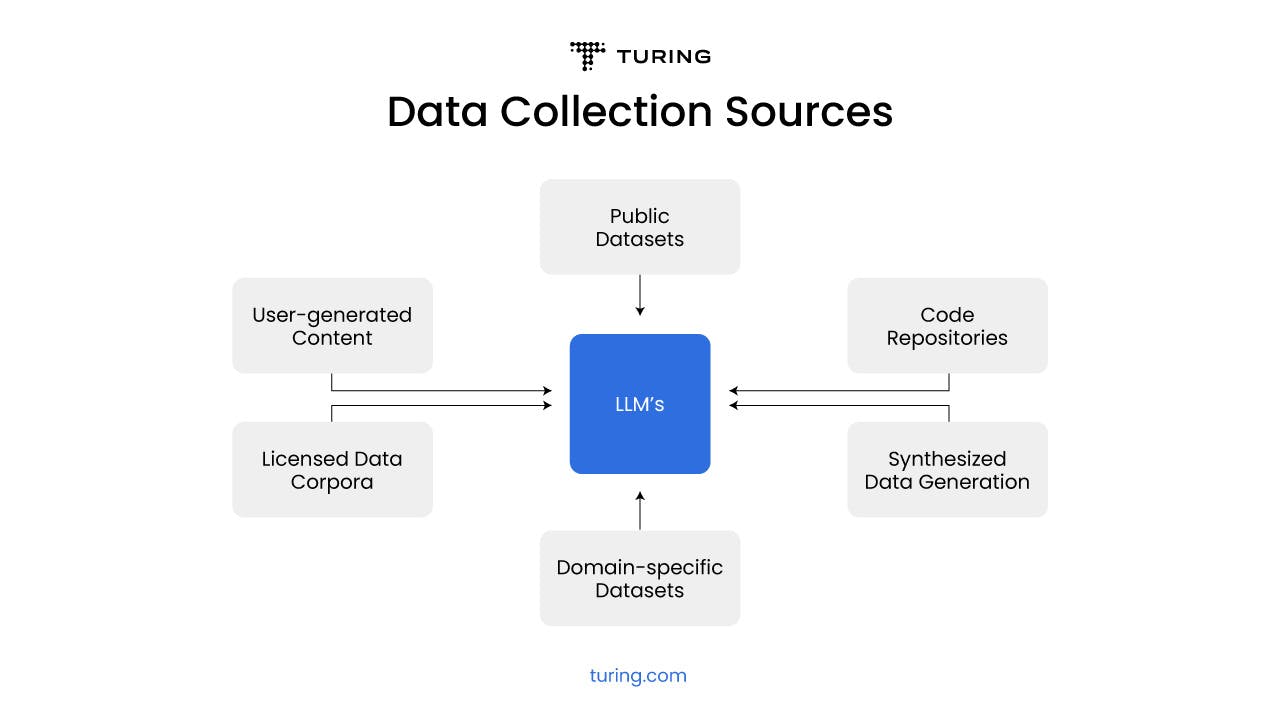
The data needed to train the LLMs can be collected from various sources to provide the models with a comprehensive dataset to learn the patterns, intricacies, and general features of a language. Some prominent sources for data collection are as follows:
a. Public datasets
Publicly available datasets contain a wide range of information from text corpora to multimedia content and are often curated by academic institutions, research organizations, and government agencies. The advantage of using public datasets lies in their diversity and scale, providing LLMs with a broad understanding of language usage across various domains.
However, there are challenges in ensuring the quality and relevance of the data as well as addressing potential biases inherent in these datasets.
Commonly used public datasets for LLM pretraining
Rather than building a web crawl from scratch, most teams start with one of these established pretraining datasets:
Dataset | Source | Approx. Size | Best For |
Common Crawl | commoncrawl.org | Petabyte-scale | General-purpose pretraining; requires heavy filtering |
FineWeb | HuggingFace(HuggingFaceFW) | 15T tokens | High-quality web text; pre-filtered from Common Crawl |
RedPajama-Data-V2 | Together AI | 30T tokens | Multilingual pretraining with quality signals |
C4 (Colossal Clean Crawled Corpus) | Google / AllenAI | 750GB | English-language pretraining; cleaner than raw Common Crawl |
Falcon-RefinedWeb | TII UAE | 5T tokens | High-quality web data with aggressive deduplication |
The Pile | EleutherAI | 825GB | Diverse mix: books, code, academic papers, web |
Wikipedia | Wikimedia Foundation | ~20GB (English) | High-quality factual grounding; often upweighted in training |
Note: If you need to train on the most recent data, working directly with raw Common Crawl snapshots gives you independence from third-party processing timelines. For most fine-tuning use cases, FineWeb or C4 provide a strong quality baseline without the infrastructure overhead of processing raw crawl data.
Common Crawl is a publicly available repository of web crawl data containing petabyte-scale snapshots of the internet, maintained by the non-profit Common Crawl Foundation and widely used as a base dataset for LLM pretraining.
b. Domain-specific datasets
Domain-specific corpora improve model performance in specialized tasks such as legal reasoning, medical analysis, or financial forecasting.
These datasets are smaller but have higher signals. Their impact depends on:
- Terminology coverage
- Contextual accuracy
- Alignment with downstream tasks
c. User-generated content
User-generated content, including social media posts, forum discussions, product reviews, and blog posts, provides a rich and diverse data source for LLMs, exposing them to conversational language, informal syntax, and real-world variation.
d. Licensed data corpora
Licensed datasets provide legally compliant, high-quality text sources such as books, research papers, and proprietary content.
They are expensive but critical for:
- Factual grounding
- Structured language patterns
- Compliance requirements
e. Code repositories
Code data enables models to learn programming patterns, documentation structure, and tool usage.
Repositories such as GitHub provide:
- Real-world coding examples
- Comments and documentation
- Debugging patterns
However, license compliance and duplication remain key challenges.
f. Synthetic data generation for LLM training
Synthetic data generation is a technique used to create artificial data to train language models. This method uses algorithms or models to generate data that mimics the characteristics of real-world data, and can be tailored to specific linguistic patterns, scenarios, or domains.
Synthetic data is used when real data is limited, sensitive, or expensive; it can scale quickly, but introduces a critical constraint:
Synthetic data amplifies the strengths and weaknesses of the model generating it. Without validation, it propagates errors rather than improving performance.
Techniques such as Self-Instruct generate instruction-output pairs using seed examples and LLMs. The Stanford Alpaca dataset, one of the first widely used instruction-tuning datasets, was generated using Self-Instruct with fewer than 200 human-written seed examples, producing 52,000 instruction-output pairs at a cost of under $500.
Data collection for fine-tuning: instruction tuning, RLHF, and DPO
Fine-tuning datasets require structured formats aligned to specific training objectives.
The three dominant fine-tuning paradigms each require a distinct data format:
Instruction tuning datasets
Instruction tuning teaches a model to follow natural language instructions across diverse tasks. Each training example consists of three components:
- Instruction: The task directive ("Summarize the following contract clause")
- Input: The context or data to work with (the contract text)
- Output: The expected response (the summary)
Instruction tuning datasets are typically collected through:
- Human annotation: Domain experts write instruction-output pairs for target tasks
- Self-Instruct (synthetic generation): A capable LLM generates new instruction-output pairs using a small set of human-written seed examples as a template, used to create the Stanford Alpaca dataset
- Existing task datasets reformatted: NLP benchmarks (summarization, QA, classification) reformatted as instruction-following examples
RLHF (Reinforcement Learning from Human Feedback) data
RLHF (Reinforcement Learning from Human Feedback) is a fine-tuning technique that uses human preference rankings of model outputs to train a reward model, which then guides the LLM toward generating responses that align with human values and preferences.
RLHF aligns model outputs with human preferences through a multi-stage process that requires two types of data:
- Supervised fine-tuning data: Human-written or human-selected high-quality responses to prompts
- Preference data: Human rankings of multiple model responses to the same prompt, used to train a reward model
Collecting RLHF preference data requires a human annotation workflow where annotators compare pairs of model outputs and select the preferred response. The quality of this preference data: consistency of annotation guidelines, annotator agreement rates, and diversity of prompts, directly determines the quality of the aligned model.
DPO (Direct Preference Optimization) datasets
DPO is a more recent alternative to RLHF that eliminates the need for a separate reward model. DPO datasets use a simple three-column format:
Prompt | Chosen Response | Rejected Response |
User query or instruction | The preferred model output | The less preferred model output |
DPO datasets can be collected through human annotation (annotators select preferred responses from model outputs) or constructed from existing RLHF datasets. The key quality requirement: the "chosen" and "rejected" responses should be meaningfully different.
Tools for collecting LLM training data

There are numerous tools used to gather data and perform extraction, transformation, and loading (ETL). These tools help streamline the data collection stage by effectively collecting data from numerous sources and loading it into a unified platform for data processing. Some prominent data collection tools are as follows:
Tool comparison overview
Use this table to quickly identify the right tool for your scale, technical level, and data source mix:
Tool | Category | Best For | Scale | Complexity / License |
Scrapy | Web Scraping | Large-scale, multi-site crawling with custom pipelines | Large | Medium / BSD |
Beautiful Soup | Web Scraping | Small-scale parsing of static HTML pages | Small–Med | Low / MIT |
Selenium | Web Scraping | JS-heavy, interactive sites requiring browser automation | Medium | Medium / Apache 2.0 |
cURL | API | Server-side / scripted API calls | Any | Low / MIT |
Postman | API | Visual API exploration and team collaboration | Small–Med | Low / Proprietary (free tier) |
Python Libraries | API | Custom collection scripts in a larger application | Any | Medium / Open Source |
Apache NiFi | ETL | Real-time streaming + visual flow design across heterogeneous sources | Large | High / Apache 2.0 |
Informatica PowerCenter | ETL | Enterprise / regulated industries needing metadata management | Enterprise | High / Commercial |
a. Web scraping tools for LLM data collection
Web crawling and scraping tools automate information extraction from websites, enabling systematic collection of diverse data types, including text, images, and structured data, into large datasets for analysis and modeling. The major web crawling and scraping tools for data collection are as follows:
1. Scrapy
Scrapy is a powerful and flexible web crawling and scraping framework written in Python. It provides a comprehensive set of tools for extracting data from websites, handling authentication, and navigating complex websites.
Scrapy is best suited for large-scale, complex web crawling projects that require scraping large data volumes from multiple sources.
2. Beautiful Soup
Beautiful Soup is a popular Python package for web scraping that provides tools for parsing HTML and XML documents. It simplifies the process of extracting data from web pages by allowing users to navigate the parse tree, search for elements, and extract relevant information.
Beautiful Soup's intuitive interface and support for different encodings and markup languages make it a go-to choice for many developers looking to extract data from websites. Beautiful Soup is ideal for smaller-scale web scraping tasks and quick data extraction needs from simple web pages.
3. Selenium
Selenium is a powerful web automation tool that allows users to interact with web browsers programmatically while enabling the automation of data extraction. Its cross-browser compatibility and support for multiple programming languages make it a popular choice for web data collection and extraction tasks.
Selenium is best used for scenarios requiring interaction with dynamic and JavaScript-heavy websites. Selenium is ideal for scraping data from websites that require user interaction, such as filling out forms or interacting with elements on the page.
b. API tools for accessing LLM training data
API-based data collection tools allow users to gather data from various web services and applications. These tools use application programming interfaces (APIs) to directly access data from sources such as social media platforms, cloud services, and other online databases. API data tools provide LLMs with access to a continuous stream of real-time or near-real-time data, which can help them learn and adapt to new information more quickly.
Some prominent API-based data collection tools are as follows:
1. cURL
cURL is a command-line tool and library for transferring data with URL syntax that supports various protocols, including HTTP, HTTPS, and FTP. cURL is widely used for interacting with APIs to retrieve data from web services. Its versatility and robust features make it a popular choice for making HTTP requests, handling authentication, and accessing data from various online sources.
With its scripting capabilities and support for numerous data formats, cURL is a valuable component in the data collection toolkit for interacting with diverse web APIs.
Best for: Server-side and scripted data retrieval pipelines where command-line automation, lightweight footprint, and shell integration matter more than a visual interface, e.g. cron-driven API ingestion.
2. Postman
Postman is a popular API-based data collection tool for building, testing, and modifying APIs. It provides a user-friendly interface that allows users to send HTTP requests and view responses, enabling efficient data extraction. Postman supports several data formats like JSON, XML, and HTML, making it versatile for different data collection needs.
It also offers features like automated testing, API monitoring, and detailed documentation. Postman offers a more visual and user-friendly way to interact with APIs, making it suitable for people unfamiliar with command-line interfaces or scripting.
Best for: Teams that need to visually explore, test, and document APIs together before building production ingestion code, especially when non-developers are involved in API selection.
3. Python libraries
Python offers a rich ecosystem of libraries for interacting with APIs and collecting data from web services. Libraries such as Requests and Tweepy provide powerful tools for making HTTP requests, accessing social media data, and parsing web content.
These Python libraries enable users to craft custom data collection scripts, interact with a wide range of APIs, and extract structured data from online sources. Their flexibility, ease of use, and extensive documentation make them valuable assets for efficiently integrating data from diverse web services. Python libraries are integrated within Python scripts and programs and are better suited for complex data processing and integrating API calls within a larger application.
Best for: Custom collection scripts that need to interleave API calls with parsing, transformation, or downstream ML logic; ideal when API responses feed directly into a training data pipeline.
Pulling data is easy. Training LLMs with it? Not so much
Let’s make it happen.c. ETL platforms for LLM data pipeline integration
Data extraction and integration platforms are instrumental in streamlining the process of gathering data from disparate sources and integrating it into a unified format for further processing. These platforms offer a range of functionalities, including data connectivity, transformation, and consolidation, that allow users to extract, cleanse, and harmonize data from various applications.
These platforms also enable data consistency and accuracy for downstream analytics and decision-making processes by providing a centralized environment for managing data extraction and integration tasks. Some prominent data extraction and integration platforms are as follows:
1. Apache NiFi
Apache NiFi is a powerful data integration platform that provides a visual interface for designing data flows across various systems. It facilitates efficient and reliable data transfer between different data sources and destinations.
With its user-friendly drag-and-drop interface, NiFi simplifies building data pipelines and performing data transformations while ensuring data quality.
Best for: Teams that need real-time data streaming, complex routing logic, and a visual no-code interface for building LLM data pipelines at scale; particularly well-suited when ingesting from heterogeneous sources (APIs, databases, file systems) simultaneously.
2. Talend
With its comprehensive set of tools for data connectivity, transformation, and governance, Talend facilitates the seamless integration of data from various databases, applications, and systems. Its user-friendly interface and extensive library of pre-built connectors enable users to harmonize and cleanse data to ensure its consistency and accuracy.
Best for: Enterprise data teams performing complex transformations across multiple source systems, especially when data quality governance and compliance reporting are required alongside ETL operations.
3. Informatica PowerCenter
Informatica PowerCenter facilitates the process of extracting, transforming, and loading data from various sources into a single, unified data warehouse. PowerCenter offers advanced features such as data profiling, data quality management, and metadata management, ensuring the accuracy and reliability of the data. Its visual interface simplifies the process of designing data integration workflows, making it a popular choice for businesses aiming to improve their data management practices.
Best for: Large enterprises with existing Informatica investments that need battle-tested ETL capabilities, metadata management, and audit trails for regulated industries (finance, healthcare, legal).
d. Pipeline orchestration and infrastructure
Collection tools get data in while the orchestration and storage infrastructure keep your pipeline running reliably at LLM scale. For production data pipelines, three components are essential:
- Apache Airflow: Workflow orchestration via Directed Acyclic Graphs (DAGs). Use it to schedule, monitor, and retry multi-stage data collection and preprocessing jobs across days or weeks of pipeline runs.
- Kubernetes: Container orchestration that lets you horizontally scale scraping, parsing, and preprocessing workloads across hundreds of nodes — critical when handling terabyte-scale crawls.
- S3-compatible object storage: The de facto standard for storing raw and processed LLM training data. Object stores scale to petabyte volumes, integrate with most ML frameworks, and decouple compute from storage so you can re-process data without re-collecting it.
Data preprocessing for LLM training
Collecting data is only the first step. Before any dataset is ready for LLM training, it must go through a rigorous preprocessing pipeline to remove noise, eliminate duplicates, protect privacy, and convert raw text into a format the model can consume.
Skipping or shortcutting preprocessing is one of the most common reasons LLM training runs produce underperforming models. Research consistently shows that up to 80% of time spent on AI projects is devoted to data preparation tasks rather than model training or deployment. Studies on models including T5, GLaM, and Gopher have shown that pre-training on cleaned data improves downstream task performance compared to training on unfiltered data.
The four core preprocessing stages are:
1. Quality filtering
Quality filtering removes documents that would degrade model performance: spam, boilerplate text, machine-generated noise, toxic content, and low-information pages. Two primary approaches exist:
Classifier-based filtering: A binary classifier is trained to distinguish high-quality documents (e.g., Wikipedia articles) from low-quality ones (e.g., spam pages). The FineWeb-Edu classifier, for example, scores web pages on their educational value and filters out low-scoring documents. The limitation: classifiers trained on English Wikipedia as the quality standard may inadvertently remove high-quality text in non-standard dialects or specialized domains.
Heuristic-based filtering: Rule-based filters applied at scale. Common heuristics include:
- Language filtering: Remove documents not in the target language(s)
- Length filtering: Remove documents below a minimum word count or above a maximum word count
- Repetition filtering: Remove documents where more than X% of the content is repeated n-grams
- Keyword filtering: Remove documents containing specific markers (HTML artifacts, adult content flags, spam indicators)
- Ratio filtering: Remove documents where the ratio of alphabetic characters to total characters falls below a threshold
Most production pipelines combine both approaches: heuristics for fast, cheap first-pass filtering, followed by a classifier for higher-precision quality scoring.
2. Deduplication
Duplicate content in training data causes two problems: it wastes compute budget on redundant examples, and it biases the model toward over-representing frequently duplicated content. Studies using the CCNet pipeline found that aggressive deduplication of Common Crawl data can reduce raw dataset size by 70% or more while improving downstream model quality.
Deduplication operates at three levels:
- Exact deduplication: Hash-based matching to identify and remove identical documents or paragraphs. Fast and cheap, but misses near-duplicates.
- Near-duplicate detection (MinHash): MinHash converts documents into compact signatures that allow efficient similarity estimation. Documents with MinHash similarity above a threshold (typically 0.8 Jaccard similarity) are considered near-duplicates. MinHash is often combined with Locality Sensitive Hashing (LSH) to avoid comparing every document pair — critical at a billion-document scale.
- MinHash is a probabilistic algorithm that estimates the similarity between two text documents by computing compact hash signatures, enabling efficient near-duplicate detection across billion-document datasets without comparing every document pair directly.
Granularity choices:
- Document-level: Remove near-duplicate documents. Fastest, but misses paragraph-level repetition.
- Paragraph-level: Hash individual paragraphs across the corpus. Catches boilerplate text (footers, navigation, legal disclaimers) that appears across thousands of pages.
- Sentence-level: Most granular and most expensive. Used by Meta's Llama 3 training pipeline.
3. Privacy redaction (PII removal)
Web-scraped data frequently contains personally identifiable information (PII): names, email addresses, phone numbers, physical addresses, and financial information. Training on PII creates legal exposure under GDPR, CCPA, and similar regulations, and can cause models to memorize and reproduce sensitive information.
Standard PII redaction approaches:
- Rule-based detection: Regex patterns for structured PII (email addresses, phone numbers, SSNs, credit card numbers)
- Named entity recognition (NER): ML-based detection of names, organizations, and locations
- Deduplication as a privacy tool: Reducing duplicate PII occurrences lowers the probability that a model memorizes specific personal details
4. Tokenization
Tokenization converts raw text into the numerical token sequences that LLMs actually process. The tokenizer is trained on your dataset and defines the model's vocabulary.
Byte Pair Encoding (BPE) is a tokenization algorithm that iteratively merges the most frequent character pairs in a text corpus into single tokens, producing a vocabulary that efficiently represents both common words and rare subword sequences.
Key tokenization decisions:
- Use an existing tokenizer vs. train a custom one: For general English-language models, reusing GPT-2's tokenizer or a similar pretrained tokenizer is common. For domain-specific models (medical, legal, code-heavy), training a custom tokenizer ensures that domain-specific terms are represented as single tokens rather than fragmented subword sequences.
- Tokenization algorithm: Most modern LLMs use BPE or a variant. SentencePiece (used by Llama, T5, and others) implements BPE at the byte level, handling any Unicode character without requiring pre-tokenization.
- Vocabulary size: Larger vocabularies (100K+ tokens) improve representation of rare words but increase model embedding table size. Most modern LLMs use vocabularies between 32K and 128K tokens.
Key challenges in LLM data collection

Building high-quality LLM data pipelines requires navigating several key challenges, including:
a. Privacy
As LLMs are trained on vast amounts of data, often containing sensitive personal information, it is crucial to safeguard individual privacy rights. This involves implementing robust measures to protect personal data, such as anonymization and data minimization techniques. Additionally, adhering to privacy regulations, such as the General Data Protection Regulation (GDPR), is essential to ensure compliance and prevent potential legal repercussions.
Striking this balance between the need for comprehensive data and stringent privacy concerns requires careful consideration of the data sources, the type of data being collected, and the intended use of the data. By prioritizing privacy and implementing appropriate safeguards, organizations can harness the power of LLMs while upholding ethical and legal standards.
b. Legal and ethical considerations
Adhering to intellectual property rights, copyright laws, and usage permissions is crucial to avoid infringing on proprietary content. Legally, organizations must comply with various data protection laws such as GDPR in Europe, CCPA in California, and others that regulate how data can be collected, stored, and used. Ethically, you must ensure the data doesn't perpetuate harmful biases or stereotypes.
To navigate this challenge, you must curate data and perform model audits to ensure compliance with relevant regulations. Additionally, when scraping data from the web or using APIs, it's crucial to respect the terms of service of the platforms. By prioritizing these considerations, organizations can responsibly harness the power of LLMs while upholding fundamental legal and ethical principles.
c. Bias and fairness issues
Bias can creep into datasets through various sources, such as skewed representation, prejudiced labels, or even through the inherent biases of the data collectors. These biases can then be learned and propagated by the model, leading to unfair outcomes or decisions. Ensuring that the training data is representative and free from bias is crucial to prevent the amplification of prejudices and inequalities.
Addressing bias and fairness concerns involves meticulous examination of the training data to identify and mitigate any inherent biases related to gender, race, ethnicity, or other sensitive attributes. These issues require careful data auditing, bias mitigation techniques, and a commitment to fairness and transparency.
d. Scalability and computational resources
The sheer volume of data necessitates efficient data storage, retrieval, and processing mechanisms. Traditional data storage and processing methods often fall short in handling such large-scale datasets and lead to performance bottlenecks and increased training time.
Leveraging distributed computing frameworks, efficient parallel processing, and optimize resource allocation can help manage the computational demands effectively. Addressing these scalability and resource constraints is crucial for ensuring optimized storage and processing of data needed to train LLMs.
e. The synthetic data contamination problem
As of 2024–2026, a significant portion of public web text is generated by LLMs themselves rather than humans. This creates a feedback loop risk: training new LLMs on Common Crawl snapshots increasingly means training on the output of previous LLMs, which can amplify model biases, degrade output diversity, and propagate factual errors across generations of models.
Mitigation strategies include using cut-off date filters to prefer pre-ChatGPT web data, AI-generated text classifiers to identify and downweight synthetic content, and reliance on verifiable human-authored sources (books corpora, peer-reviewed papers, curated Wikipedia) as quality anchors in the training mix.
Wrapping up
The diversity, quality, and scale of training data ultimately define how well an LLM performs across tasks. Building high-quality datasets requires combining multiple data sources, applying structured collection methods, and enforcing rigorous preprocessing at every stage. Without filtering, deduplication, privacy controls, and careful tokenization, even large datasets introduce noise that degrades model performance.
This is where structured approaches, including human-in-the-loop review and iterative validation, help ensure that data quality improves with each training cycle instead of degrading. This system-level approach to data quality, where collection, preprocessing, and evaluation operate as a single loop, is increasingly how frontier teams structure post-training pipelines to produce reliable model behavior at scale.
Build high-quality training datasets with Turing
Get curated datasets designed for post-training workflows, combining domain-specific data, structured preprocessing, and evaluation-ready formats.
Request SampleAuthor
Huzefa Chawre
Technical content writer at Turing specializing in large-scale data quality operations, and model evaluation systems for generative AI. He has contributed to multimodal projects for frontier AI labs, leading initiatives across quality assurance, tooling optimization, and scalable data workflows.
Share this post

AGI Advance Newsletter
Weekly updates on frontier benchmarks, evals, fine-tuning, and agentic workflows read by top labs and AI practitioners.
Subscribe Now