
The AI landscape is evolving rapidly, and Alibaba’s latest model, QwQ-32B, marks a significant leap forward in reasoning-driven AI. With 32 billion parameters, QwQ-32B challenges the assumption that bigger models are always better by delivering high-level logical reasoning at a fraction of the scale of massive AI systems. Positioned as an open-source alternative to proprietary reasoning models, it introduces enhanced critical thinking, extended context processing, and agent-like problem-solving—unlocking new possibilities for enterprise AI applications.
What is QwQ-32B?
QwQ-32B (short for Qwen-with-Questions) is Alibaba’s latest AI model designed specifically for advanced reasoning tasks. It stands apart from general-purpose models by approaching queries like an “eternal student”—internally reflecting on its answers before finalizing a response. This introspective approach makes it highly effective for complex domains such as:
- Mathematics: Achieving top-tier performance in structured problem-solving.
- Code generation & debugging: Verifying outputs through self-evaluation.
- Scientific and analytical queries: Processing long-form technical content without losing context.
Under the hood, QwQ-32B leverages:
- Rotary Position Embeddings (RoPE) for improved sequence understanding.
- Grouped Query Attention (GQA) for efficient memory usage.
- Extended context length (up to 131K tokens, surpassing many proprietary models).
- Reinforcement Learning (RL) for self-reflection, enabling iterative self-correction.
By prioritizing thoughtful problem-solving over raw parameter size, QwQ-32B competes with models several times its scale while remaining more cost-efficient and deployable.
How does QwQ-32B stand out?
1. Reinforcement Learning (RL) at scale
QwQ-32B is one of the first open-weight models to successfully scale RL for reasoning tasks, with a training process designed to enhance both domain-specific accuracy and general problem-solving skills:
Stage 1: Task-specific RL for math and coding
- Uses an accuracy verifier for math solutions to ensure correctness.
- Implements a code execution server to test whether generated code passes real-world test cases.
Stage 2: Generalized RL for broader capabilities
- Integrates reward-based training for instruction following and alignment with human intent.
- Enhances agent capabilities, enabling the model to interact with tools and refine its reasoning dynamically.
By optimizing the feedback mechanisms used during RL training, QwQ-32B achieves state-of-the-art reasoning efficiency without requiring a massive increase in parameters.
2. Extended context window: Processing large-scale information
QwQ-32B’s 131K-token context window is among the longest of any publicly available model. This means it can:
- Analyze hundreds of pages of legal documents without breaking context.
- Process multi-step financial reports in a single query.
- Handle dense research papers or long software logs, making it a powerful tool for knowledge-intensive industries.
3. Open-source & enterprise-friendly deployment
QwQ-32B is released under an Apache 2.0 license, allowing enterprises to fine-tune, modify, and self-host the model—a significant advantage over closed systems. Businesses gain:
- Full control over data privacy and compliance.
- Lower costs compared to API-based models.
- Customizable tuning for domain-specific expertise (e.g., finance, legal, engineering).
Performance: How does QwQ-32B compare?
QwQ-32B delivers state-of-the-art results across several reasoning benchmarks, demonstrating competitive performance against models much larger in scale:
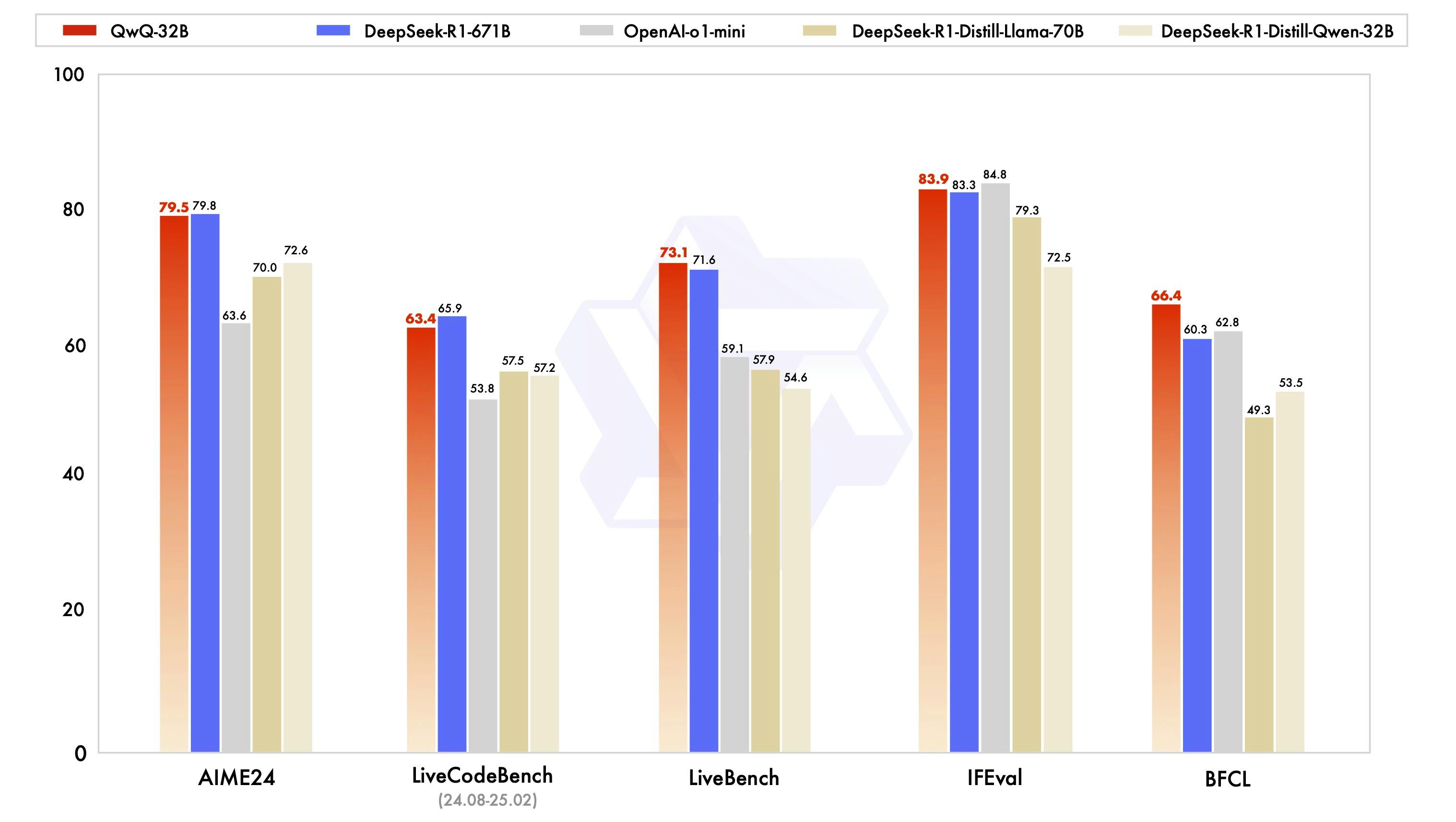
Alibaba’s benchmark evaluations show that QwQ-32B:
- Matches the performance of DeepSeek-R1, a 671-billion-parameter mixture-of-experts model, while using significantly less compute.
- Outperforms OpenAI’s o1-mini, a distilled variant of GPT-4.5-class models, in math, logic, and structured problem-solving tasks.
- Achieves enterprise-grade accuracy, making it a compelling alternative to proprietary AI services.
Hugging Face’s Vaibhav Srivastav highlighted QwQ-32B’s record-breaking inference speed via Hyperbolic Labs, noting that while the model tends to overthink, its rapid generation capabilities set a new benchmark for efficiency.
What are the enterprise applications of QwQ-32B?
The reasoning-first approach of QwQ-32B makes it a strategic asset for businesses looking to integrate more intelligent AI-driven decision-making into their workflows. Key enterprise applications include:
1. Complex decision support for finance & legal sectors
- Processes financial models, risk assessments, and investment reports with multi-step reasoning.
- Reviews legal contracts and compliance documents, identifying inconsistencies or risks.
- Handles large-scale knowledge retrieval tasks across thousands of pages.
2. AI-driven code generation & debugging
- Automatically generates and refines code with built-in validation steps.
- Debugs large-scale enterprise codebases by executing and evaluating test cases.
- Integrates with developer workflows, reducing manual debugging time.
3. Autonomous AI agents & knowledge workflows
- Uses agentic reasoning to interact with databases, tools, or APIs for real-time insights.
- Assists in scientific research, summarizing papers and validating hypotheses.
- Enhances customer support automation, handling multi-turn, logical conversations.
What challenges should enterprises consider before deploying QwQ-32B?
While QwQ-32B introduces major advancements, enterprises should be mindful of the following:
1. Language mixing & code-switching
Due to its bilingual training data, the model may unexpectedly switch languages mid-response, requiring fine-tuning for monolingual applications.
2. Recursive reasoning loops
QwQ-32B’s introspective nature can sometimes result in overthinking—where the model continuously refines an answer without reaching a conclusion. Prompt engineering or tuning may be required for production systems.
3. Hardware considerations
Despite being smaller than 100B+ parameter models, QwQ-32B still requires high-performance GPUs for inference. However, with 4-bit quantization, it can run on single-GPU systems, making it more accessible than larger proprietary models.
Conclusion
Alibaba’s work with QwQ-32B demonstrates that scaling RL—not just model size—is the key to unlocking the next generation of AI reasoning models. Moving forward, we expect:
- More scalable RL techniques, allowing even smaller models to achieve state-of-the-art reasoning.
- Deeper agent integration, enabling AI to autonomously use external tools for decision-making.
- Further improvements in multilingual processing, reducing language-mixing tendencies.
At Turing, we specialize in post-training optimization, enterprise-scale AI infrastructure, and AGI-driven advancements.
Talk to an expert to explore how Turing AGI Advancement can help refine foundation models, enhance post-training strategies, and scale AI infrastructure for measurable enterprise impact.
Want to accelerate your business with AI?
Talk to one of our solutions architects and start innovating with AI-powered talent.