

Scaling AI-Powered Development: An Enterprise Roadmap for Claude Code

Mohan Pasappulatti
•11 min read
- Frontier AI
- Languages & Frameworks

Enterprise Claude Code deployments need a strong foundation
Successfully deploying Claude Code at enterprise scale takes more than a quick setup. Unlike basic autocomplete, it functions as an agentic co-developer, capable of solving complex problems, navigating large codebases, and following architectural rules.
That capability raises the bar for what your organization needs to have in place. The biggest risk isn't the AI underperforming; it's launching without the foundation that keeps agentic work reliable in production: defined workflows, enforceable governance, and integration into day-to-day engineering practices.
This guide outlines how to build that foundation, and how to move AI-powered development from early experimentation to a repeatable operating model.
What changes when AI moves from reactive to proactive
Conventional AI tools, such as assistants and copilots, operate reactively. They wait for developers to write code, then suggest what to do next.
Claude Code introduces a co-developer agent, shifting from reactive suggestion to proactive execution. Developers state the desired final outcome, and Claude Code assumes the task, analyzing the codebase, making architectural decisions, and implementing multi-file modifications.
This changes the workflow: instead of manually coding in an IDE, the developer uses a terminal to delegate tasks, e.g., "Incorporate input validation into all API endpoints within the users service, adhering to the established patterns found in the orders service." Claude Code executes, cross-analyzing and enforcing patterns and reducing hours of repetitive work to minutes.
This efficiency requires the developer's focus to shift from "how to construct the code" to "how to precisely specify, constrain, and verify the implementation.” Developers must now define success criteria, system constraints, and edge cases, focusing on task delegation over managing implementation details.
Start with the right use cases: What Claude Code should (and shouldn’t) do
Not every coding task belongs with an AI agent, and treating Claude Code as a universal solution is the fastest way to get disappointed. Successful enterprise adoption starts with a clear decision framework: when to use Claude Code, when to rely on traditional engineering, and when simpler copilot tools are enough.
Traditional engineering remains essential for high-stakes work: architectural decisions, user-facing features that need stakeholder input, and systems where deep domain expertise is non-negotiable. In these areas, tools like a copilot play a supporting role, speeding things up with autocompletion and inline suggestions but not changing how the work gets done.
Claude Code does its best work on high-volume, rule-based tasks that follow established patterns. Good starting points are areas with high friction and rigid logic (validation layers, data transformation, API integrations) where consistency across files matters more than creative judgment. Repetitive internal tooling is another natural fit: ETL scripts, config generators, test updates, and schema migrations. These tasks are unglamorous, but they quietly consume senior engineering time.
For initial deployments, teams should prioritize systems with limited user exposure and low edge-case variability, focusing on internal tools, backend services with solid test coverage, and refactoring work. New user-facing features can follow after teams prove controls and review workflows in lower-risk contexts.
Just as important is knowing where not to start. Mission-critical systems with unpredictable state (think payment processing, authentication, and data privacy controls) are poor early candidates. The cost of failure is high, and these areas often demand domain expertise that goes beyond pattern matching. The same is true for workflows with constant stakeholder churn. Claude Code thrives on stable, well-specified requirements. If the goalposts are still moving, you’ll spend more time re-prompting than you would writing the code yourself. Clear boundaries reduce wasted cycles and reduce risk.
Claude-in-the-loop: Designing your SDLC for co-development
Integrating AI-generated code, like that from Claude Code, requires intentionally designing the development lifecycle: what gets delegated, how output is reviewed, and where human judgment still applies.
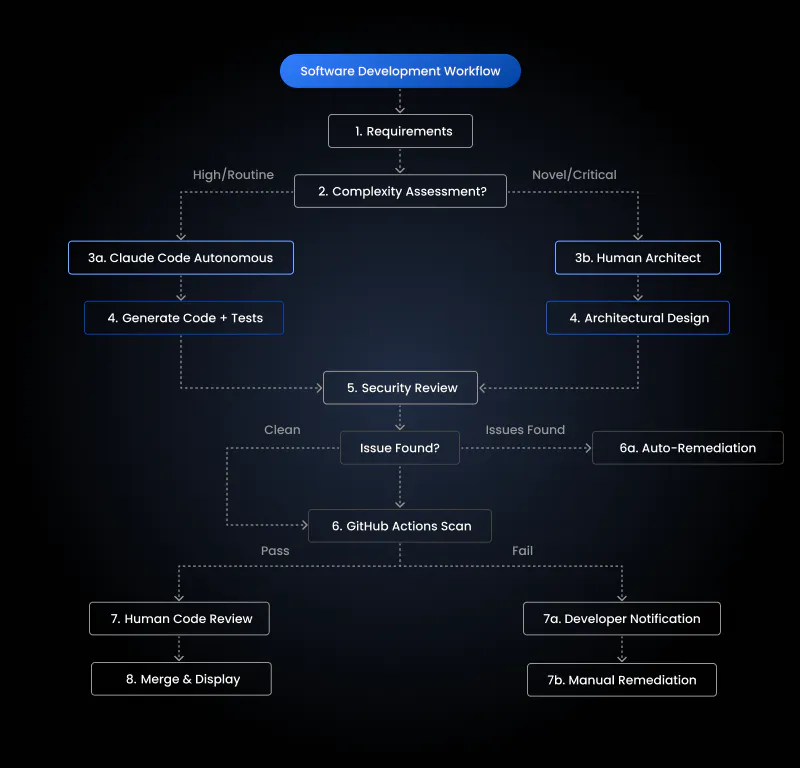
Human-AI checkpoints matter most at risk boundaries. Teams should delegate well-scoped tasks with clear success criteria and escalate review for anything that touches security, privacy, or core business logic. Claude Code can implement the change, but humans must validate the approach before shipping. Reviewers should also override code that passes tests but conflicts with architectural principles or long-term maintainability. Teams build reliability when they train for those decisions and enforce them consistently.
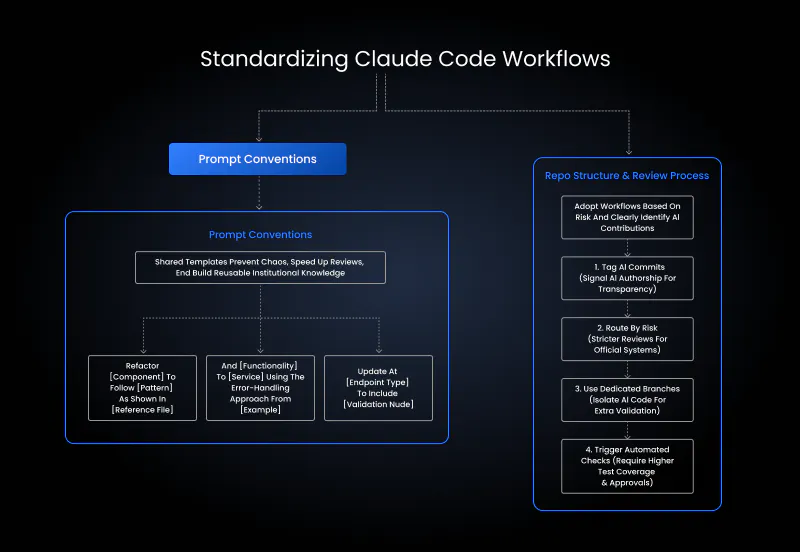
Consistency is key and starts with established prompt conventions. Teams should use shared templates for recurring operations:
- “Refactor [component] to follow [pattern] as shown in [reference file].”
- “Add [functionality] to [service] using the error-handling approach from [example].”
- “Update all [endpoint type] to include [validation rule].”
These patterns make reviews faster because everyone knows what the agent was asked to do. Over time, good prompts become reusable institutional knowledge that can be documented and taught.
Repository and review practices also need to adapt. AI-generated commits should be clearly tagged. In many cases, they should be reviewed by engineers who understand both the codebase and how the agent behaves. Workflows should vary based on risk; stricter review paths for critical systems and lighter ones for internal tooling. Some teams use dedicated branches for AI-generated code with extra validation before merge. Others trigger automated checks when commit messages signal AI authorship like higher test coverage requirements or additional approvals.
Governance means embedding technical standards directly into how Claude Code works. Set explicit test coverage thresholds for AI-generated changes. Use commit tagging so AI contributions are visible in version history. Inject hard constraints into prompts:
- “All database queries must be parameterized.”
- “All API endpoints must include rate limiting.”
- “Error messages must not expose internals.”
These rules shape the output long before a human reviewer ever sees it.
Scaling Claude Code in enterprise environments
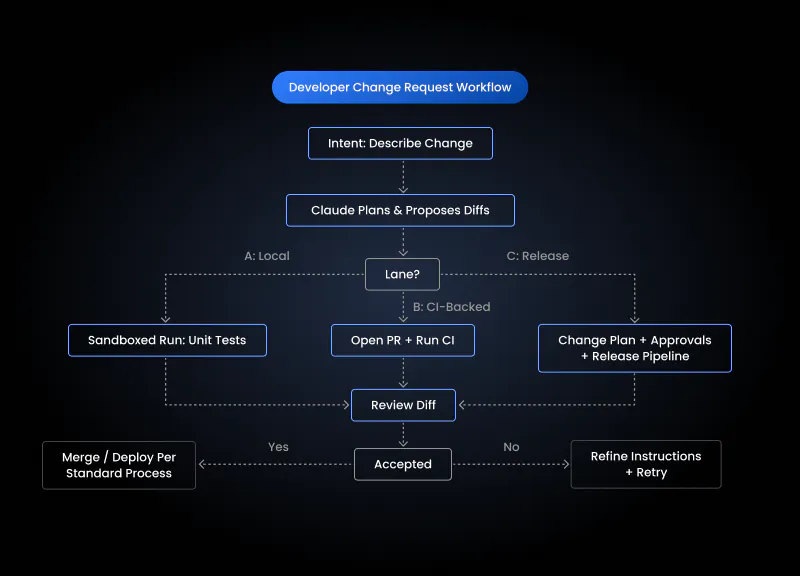
Scaling co-development means bringing Claude Code into existing SDLC without compromising the governance protocols already in place. The goal is consistent, predictable behavior across every repository and team. To manage that transition, we've structured the work into three lanes:
Lane A — Local Exploration (Minimal Friction): Developers use Claude in a sandbox to analyze code, propose diffs, and run unit tests. This enables rapid, low-risk validation before formal submission.
Lane B — CI-Backed Changes (Standard Operational Procedure): All production modifications must pass the CI/CD pipeline. This process ensures changes clear CI, generating an auditable artifact (PR, build logs, test results) for quality assurance.
Lane C — Release and Deployment (Maximal Assurance): Changes here face the highest control. Human operators retain final release authority, mandating formal approvals, strict change management, and controlled deployment (e.g., canary releases, rollback). Claude assists with auxiliary tasks (e.g., release notes) but deployment execution and critical decisions are human-governed.
Build fast, but build traceably
Rapid development with generative models like Claude Code requires strict accountability and observability. Claude Code can move fast, but the real responsibility is making sure that faster code is still observable, accountable, and debuggable when something breaks.
From day one, Claude-generated code should run through the same CI/CD and version control pipelines as human-written code. Tests, security scans, performance checks, and deployment gates all apply.
Beyond that, add risk scoring based on scope and impact. Larger, multi-file changes warrant higher scrutiny. AI-generated changes also need clear explanations baked in, and the most practical place for that is the commit message. Require Claude to articulate not just what changed, but why, for example: "Refactored authentication module to use OAuth2 as specified, following the pattern from the authorization service in commit abc123."
Traceability Mechanisms:
- Transcript Retention: Retain transcripts for 7-14 days for debugging while limiting sensitive data exposure.
- Git Attribution: AI-generated code must be co-authored in commits to track AI contributions.
- Decision Logging: MCP server interactions require comprehensive logging of tools used, data accessed, and initiating user identity.
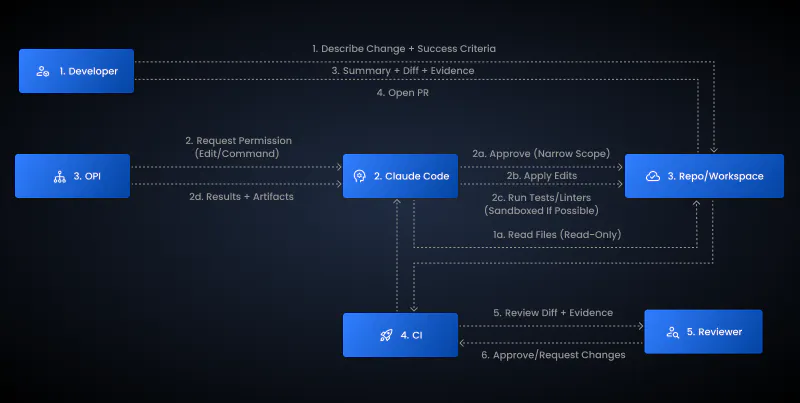
Accountability requires a direct answer to a common question: who owns a failure when Claude Code ships a bug? The answer can’t be “the AI.” A developer delegated the task, reviewed the output, and approved the merge. Accountability for defects in AI-generated code rests with the human, not the AI. This accountability layer ensures someone understands what was built, why it was approved, and how to fix it when things go wrong. Track who requested each AI-generated change, who reviewed it, and what validation steps were completed.
Teams also need to protect against shadow code: AI-generated logic that slips into production without proper tests, docs, or observability. Full traceability from test to production reduces this risk. AI-generated code must meet the same coverage, documentation, and monitoring thresholds as human code. If an incident can’t be traced back to the exact code that caused it, including whether it was written by a human or an AI and what instructions drove it, observability is insufficient. Move fast, but build systems that support equally fast diagnosis and remediation.
Measuring productivity gains beyond lines of code
Most enterprises make the mistake of measuring AI coding tools against traditional developer metrics: lines of code written, commits per day, tickets closed. These metrics were always problematic for human developers, and they misrepresent the value proposition of AI assistance.
Claude Code's value is that it frees developers to focus on higher-leverage activities. The right metrics should reflect this shift:
- Time to deliver well-defined features: Measure how quickly teams move from specification to tested implementation. When Claude Code handles repetitive patterns and boilerplate, developers can focus on design, architectural validation, and quality assurance, which can compress feature cycle time.
- Quantifiable reduction in repetitive work: Track time spent on boilerplate, API integrations, and pattern replication, and compare it to time spent on novel logic and creative problem-solving.
- Code review cycle efficiency: Measure whether reviews accelerate because reviewers focus on logic, architecture, and edge cases rather than syntax and style.
- Developer satisfaction and retention: Monitor qualitative feedback on work quality, focus time, and perceived burnout tied to repetitive tasks.
- Innovation capacity: Track how much time remains for exploratory R&D, technical debt reduction, and architectural improvement. As AI handles more implementation work, this number should increase.
The most successful Claude Code adoptions will be measured by expanded technical ambition: features teams prioritize, technical debt teams retire, and experiments teams run. When developers stop spending so much of their time on mechanical implementation, what do they build with that freed capacity? That's the metric that matters.
Enterprise-wide impact: From engineering tool to organizational template
Claude Code turns engineering into the proving ground for agentic AI across the enterprise. When development teams learn how to delegate work to an agent, enforce guardrails, and assign human accountability, they create a repeatable blueprint other teams can follow. The real-world production insights (when to delegate, when to step in, how to measure value beyond raw output) can apply directly to legal, finance, operations, and support functions.
Governance built for Claude Code is what makes this scale. Constraint enforcement, human review points, risk scoring, and audit trails are the same concerns every team will face when they deploy agents. Engineering leaders define access permissions, codify review procedures, and establish decision-source tracing. When teams document what works and codify patterns, engineering can operate as a center of excellence for agentic AI.
As other teams see engineers trust agents with high-stakes work, confidence spreads. Product explores agents for competitive analysis and specs, ops looks at provisioning and incident playbooks, finance considers reconciliation and compliance workflows. This success transitions AI from a cautious observation to a real organizational asset.
As Claude’s capabilities improve in reasoning, context handling, and task decomposition, organizations that already operate agentic workflows can adopt improvements faster. Improvements in codebase comprehension and implementation reliability translate into faster delivery, improved quality, and more time available for strategic engineering work.
But the real advantage is the organizational maturity built along the way. The governance models, delegation protocols, structured review mechanisms, and foundational trust frameworks established for Claude Code will serve as the enterprise-wide blueprint for agent adoption.
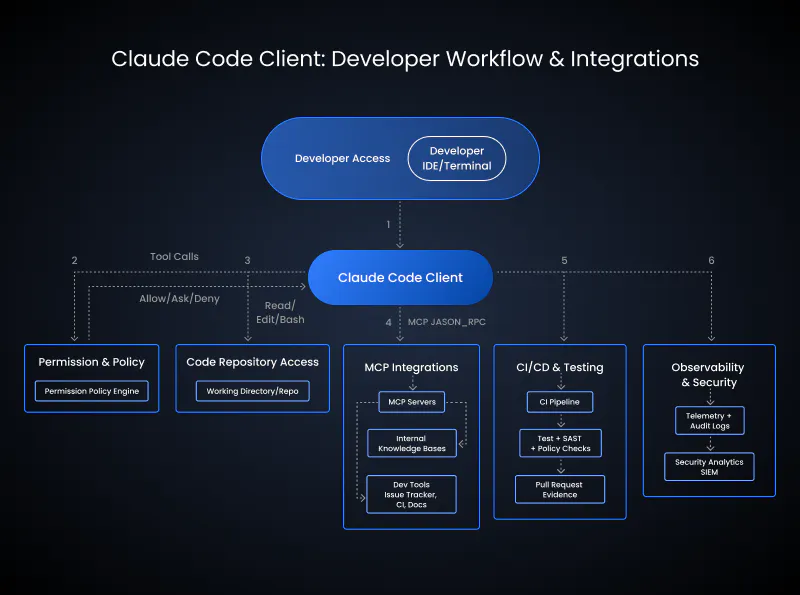
Turn agentic capability into production reality
Enterprises don’t fail at AI adoption because the model falls short. They fail because the model isn’t operationalized, governed, or integrated into real production environments. This is where Turing comes in.
Anthropic delivers frontier capability. Turing turns that capability into durable enterprise intelligence. We embed Claude Code into production workflows with the controls that matter: governance frameworks, real-time observability, continuous evaluation cycles, stringent security protocols, and seamless alignment with CI/CD pipelines. The result? Agentic systems that operate inside your data, your architecture, and your compliance standards. With Turing, Claude Code can produce defensible, auditable, production-ready outcomes tied to real KPIs. Claude Code serves as the underlying engine, and Turing guarantees its reliable and scalable operation throughout the enterprise.
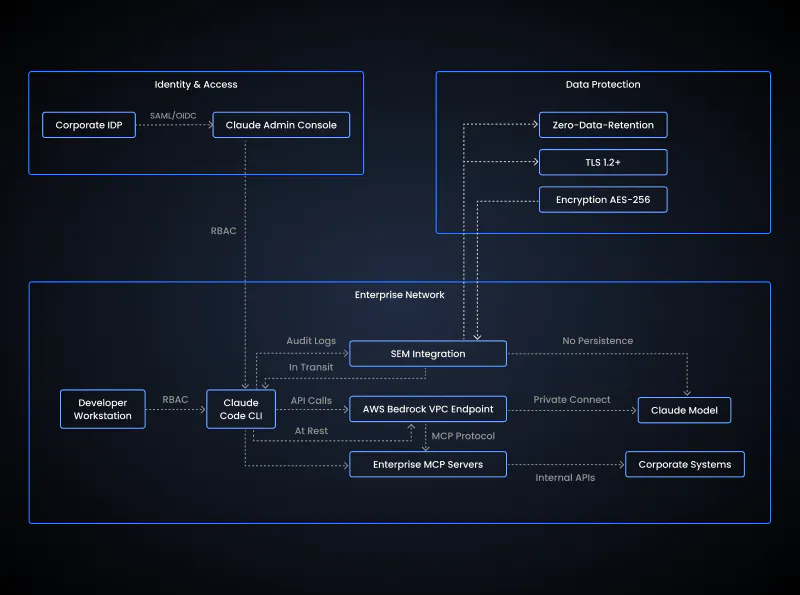
Production Readiness Checklist:
- Formal execution of the Zero-Data-Retention addendum for processing sensitive data
- Review of the SOC 2 Type II audit documentation (available under a Non-Disclosure Agreement)
- Completion of HIPAA compliance validation (where applicable)
- Verification of Virtual Private Cloud (VPC) isolation testing and confirmation of secured traffic flow
- Integration of the Compliance API with the existing Security Information and Event Management (SIEM) infrastructure
- Establishment of a comprehensive developer training program emphasizing secure coding practices
- Update of incident response procedures to address vulnerabilities stemming from AI-generated code
- Validation of established rollback procedures for deployments leveraging AI assistance
What to get right before you scale
Agentic AI represents an architectural paradigm shift: The proactive capabilities of Claude Code require rethinking SDLC workflows, permission architectures, and governance frameworks, moving beyond incremental integration.
Security must be policy-first: Enterprise deployment requires mandatory enforcement of managed-settings.json, establishment of VPC isolation, and deployment of Zero-Data-Retention configurations prior to granting developer access.
Quantify outcomes, not activity metrics: Shifting developer effort from repetitive coding to high-value activities (architectural design, innovation, in-depth code review) will accelerate feature delivery, enhance developer satisfaction/retention, improve code review efficiency, and increase capacity for strategic innovation and technical debt reduction.
AI productivity requires enterprise integration: Individual gains dissipate at the organizational level without systemic integration and architectural maturity.
The Model Context Protocol (MCP) facilitates extensible, governable integration: MCP transforms isolated AI assistance into coordinated enterprise workflows, ensuring comprehensive audit trails and robust access controls.
Cross-functional impact extends beyond engineering: Security, legal, and business teams can leverage Claude Code for control flow analysis, rapid prototype development, and process automation.
Compliance remains an organizational responsibility: Enterprises are responsible for implementing their own access management, comprehensive audit logging, and rigorous vendor risk controls.
Adoption velocity establishes a competitive moat: Early adopters who establish robust governance frameworks and operational expertise will gain durable advantages as AI-native development becomes the industry standard.
These principles reinforce each other. Governance makes delegation safe. Traceability makes speed defensible. And the right use case boundaries make sure AI effort lands where it actually creates value. Organizations that get these foundations right build the operational maturity to scale agentic AI across the entire enterprise.
If you’re exploring Claude Code and want to deploy it safely inside real engineering workflows, talk to a Turing Strategist about turning agentic capability into production-ready systems.
Build with the world’s leading AI and Engineering talent
Whether you need an agentic workflow, a fine-tuned model, or an entire AI-enabled product, we help you move from strategy to working system.
Realize the value of AI for your enterpriseMohan Pasappulatti is a technology executive who turns AI strategy into growth, margin improvement, and operational performance. He partners with C-suite leaders and leads AI transformations for organizations ready to move from experimentation to enterprise-scale impact. He defines the business strategy, technical roadmap, platform architecture, and aligns cross-functional teams and partners around measurable outcomes — faster growth, higher margins, and durable competitive moats. He has delivered AI and ML solutions across Adtech/Martech, Fintech, Healthcare & Life Sciences, eCommerce, Travel, Media & Entertainment, and Industrial markets, and now focuses on generative AI as the lever that accelerates every one of those outcomes.
Share this post

Want to accelerate and innovate your IT projects?
Talk to one of our solutions experts and make your IT innovation a reality.
Get Started