

Improve AI trust and alignment with structured safety data
Evaluate and strengthen model safety through structured post-training data, adversarial test sets, and alignment evaluations designed to identify and mitigate harmful, adversarial, and unsafe behaviors in foundation models.






Advancing safety through unified domains
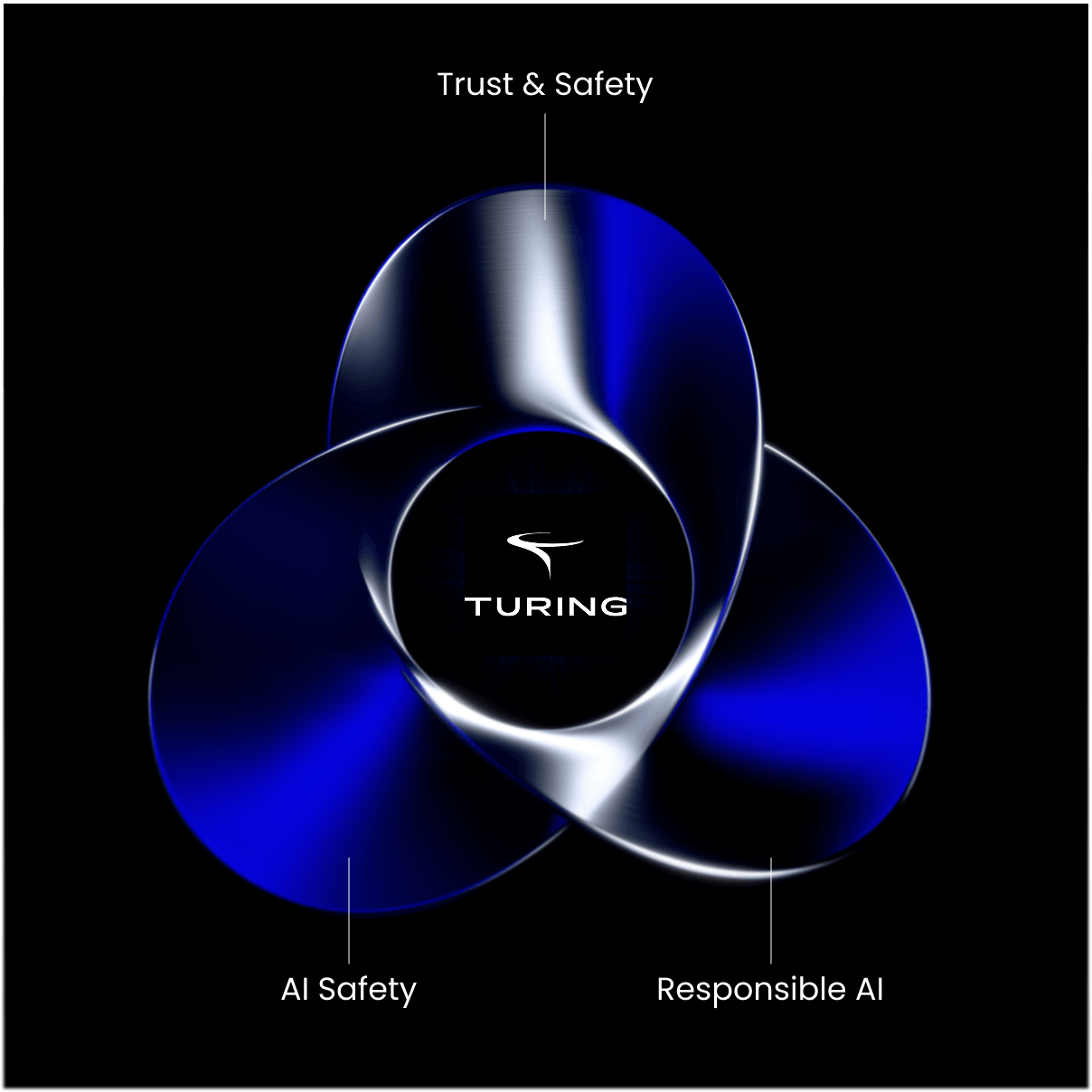
Turing advances human-centered AI through industry-leading expertise at the intersection of Trust & Safety, AI Safety, and Responsible AI. This unified approach helps labs detect harmful outputs, measure reliability, and ensure models behave consistently with human intent.
See how we evaluated agent safety across 24,000+ real tool-use conversations.
Safety capabilities

Trust and Safety
- Edge-case and model-breaking trajectories for performance gap testing
- Identify culturally nuanced adversarial content aligned with policy frameworks
- Design and refine label taxonomies for abuse, harm and other high-risk policies

AI Safety
- Red-teaming programs that surface behavioral vulnerabilities in multimodal systems
- Safety datasets built on mental health, emotional reliance, and self-harm benchmarks
- Single-and multi-turn trajectory datasets across benign, borderline, and high-risk behaviors

Responsible AI
- Curated datasets to test fairness, inclusiveness and reliability across diverse personas
- Evaluate model performance across diverse languages and underrepresented groups
- Design tasks and ground-truth datasets for refusal, soft refusal, and compliance
End-to-end safety coverage
Turing delivers evaluations, benchmarks, and datasets, giving labs structured signals to measure, compare, and improve model behavior under real-world risk.

Safety and Robustness
Our evaluations and benchmarks reveal failure modes, quantify safety performance, and track improvement across refusal behavior, honesty, harmlessness, and reliability.
Coverage includes:
- Adversarial red-teaming and jailbreak suites
- Harmful-output detection and model-breaking trajectories
- Custom safety datasets for mental health and sensitive content

Alignment
Structured signals to evaluate and improve how models handle refusal behavior, truthfulness, and policy consistency in safety-critical contexts.
Coverage includes:
- Rules-based and constitutional alignment datasets with ideal responses
- Safety-tuning datasets for safe refusals and safer alternatives
- Red-team prompt and response corpora for high-risk safety fine-tuning

Trust and Safety
Evaluate how models detect harmful content, resist prompt attacks, and adhere to platform safety rules using consistent, policy-aligned labeling.
Coverage includes:
- Harmful-content identification and classification
- Safety policy and taxonomy refinement for borderline and ambiguous cases
- Stress-testing for complex, policy-sensitive cases

Bias, Fairness, and Ethics
Measure how models perform across demographics, languages, and risk groups using controlled tests and human judgment.
Coverage includes:
- Human-judgment bias and fairness evaluations
- Model performance analysis by demographic, language, and risk cohort
- Evaluation sets for underrepresented or misrepresented populations

Multimodal Safety
Evaluate how models behave across image, video, audio, and text, exposing safety risks that emerge only when modalities interact.
Coverage includes:
- Dataset curation across safety and sensitive categories
- Safety and harmful datasets labeled across broad safety policies
- Integrated safety features built into annotator tools

Wellness and Resiliency
Designed to reduce exposure risk and sustain performance across multilingual and multimodal contexts.
Support includes:
- Proactive, evidence-based care
- Research-validated psychometrics
- 24/7 on-demand support
Structuring safety evaluation for frontier AI
Strengthen model trust with structured safety evaluation

Safety criteria and risks
We work with labs to specify the safety criteria, failure modes, and domain risks that inform evaluation strategy.

Reproducible, auditable pipelines
We create structured evaluation pipelines where every prompt, output, and judgment is traceable end to end.

Domain-specific expertise
Clinical and mental health experts, including licensed practitioners, help design scenarios and interpret outputs to ensure evaluations reflect real-world risk.

Human-in-the-loop + AI feedback loops
Expert review and model-assisted scoring work together to surface edge cases and confirm reproducibility.

Structured test cases
We convert safety policies into concrete labels, schemas, and adversarial scenarios that define expected model behavior.
Evaluation across domains and modalities
We run safety tests across text, image, audio, video, and domain workflows to reveal multimodal and context-specific risks.
Actionable safety signals
We provide interpretable results, targeted datasets, and clear improvement paths to strengthen trust and alignment.
Strengthen model trust with structured safety evaluation
Get a structured evaluation set that reveals jailbreaks, harmful outputs, and failure modes across modalities.
FAQs
How quickly can we receive sample safety data?
Most safety sample sets can be shared in under 48 hours so labs can begin evaluation immediately.
Do you support multimodal safety testing?
Yes. We provide safety evaluations and datasets across text, image, video, and audio to help labs measure safety consistently across modalities.
Can Turing work with our existing safety policies?
Yes. We map your policies into structured label schemas and build evaluation sets that test the boundaries, edge cases, and gaps within those policies.
Can datasets be customized to specific risks or regions?
Yes. We support custom domains, specialized risk categories, localized safety norms, and multilingual evaluation sets.
Ready to evaluate and improve AI safety?
Work with Turing to strengthen trust, alignment, and safety across your AI systems.
AGI Advance Newsletter
Weekly updates on frontier benchmarks, evals, fine-tuning, and agentic workflows read by top labs and AI practitioners.