

Buy, build, or hybrid? 4 questions to shape your AI strategy

Mohan Pasappulatti
•6 min read
- Frontier AI
- Languages & Frameworks

AI initiative failure rates doubled in a year. Delivery model is often why.
Between 2024 and 2025, the number of companies abandoning most of their AI initiatives jumped from 17% to 42%. That failure rate is weighing on AI decision-makers in 2026, with 61% of CEOs saying they’re under higher pressure to show returns from AI investments than a year ago.
The need to deliver results is clear, but doing so isn't as simple as prioritizing speed. Organizations also need to weigh risk, control, and resource constraints, all of which can slow value creation or work against it.
Getting the delivery model right often determines whether an AI initiative succeeds or stalls. Buy, build, or some combination? It's one of the most consequential decisions leaders face, and one of the most debated.
This piece works through that decision across 4 dimensions: speed, risk, control, and maturity.
Failure Mode | Early Signal | Executive Fix |
Unclear sponsor | “Everybody wants it” means nobody owns it. | Mandate a dedicated, accountable owner |
Weak problem framing | Demoable but not measurable | Define KPIs before starting |
Data friction | Persistent access, quality, or schema issues | Validate data readiness first |
Integration debt | Agents require complex workflow integration | Build auditable connections to existing workflows |
No ops plan | Evaluation and monitoring unfunded | Budget for monitoring, security, and ongoing evals |
Buy, build, or hybrid: 4 dimensions that drive enterprise AI decisions
Time-to-value: How quickly must you demonstrate measurable business impact?
Almost every AI decision involves a trade-off between speed and control.
In practice, one usually comes at the expense of the other. Building gives maximum control, but costs time. Buying delivers faster deployment, but with less flexibility over model behavior, logic, and governance.
Leaders need to consider not just what they want, but what they’re willing to trade to get it.
When to buy: When the business needs measurable impact quickly (within 3-6 months) and there’s no competitive advantage gained from owning models, data, and logic.
When to build: When control over models, data, and logic is critical and the organization can support a 12–24 month investment to realize it.
When to go hybrid: When the organization wants to deploy core capabilities quickly and build differentiating components over time.
Regulatory exposure: What compliance requirements govern your use case?
All AI outputs should be explainable, traceable, and defensible. And in some industries, this is a regulatory requirement. Frameworks like the EU AI Act, sector-specific regulations in healthcare and financial services, and growing audit expectations set clear parameters for how AI systems are developed, deployed, and monitored.
Regulatory exposure varies by geography and industry, but the bigger determining factor is usually the use case itself. The same organization can face very different levels of scrutiny depending on what the AI is actually doing. For example, in healthcare, an AI system that supports clinical decision-making, such as recommending treatments or prioritizing patients, carries high regulatory risk. Outcomes directly affect patient safety, which means strict requirements for oversight. An AI tool used to generate patient education materials or summarize clinical notes sits in a much lower-risk category. The consequences of error differ, and regulatory scrutiny reflects that.
Where a use case sits on the regulatory spectrum shapes more than implementation. It often determines whether an off-the-shelf solution can meet your needs or whether you need deeper ownership and control.
When to buy: Off-the-shelf solutions may be sufficient for low-risk, standardized use cases, such as marketing or customer service, or non-customer facing applications.
When to build: In high-risk, regulated environments, building provides more complete visibility into model behavior and ensures decisions meet strict governance and accountability standards.
When to go hybrid: A hybrid approach works well when some use cases need oversight, but full ownership of the entire tech stack isn't necessary. Separating out these elements can help organizations move faster, reduce complexity, and lower costs without compromising on regulatory requirements.
Control requirements: How much control do you need over IP, data sovereignty, model behavior, and audit trails?
Some AI use cases sit at the core of competitive advantage. An underwriting model in insurance or a demand forecasting engine in consumer goods directly influences revenue, cost, and risk. In those cases, companies need full control over how AI models interact with underlying data and IP.
Many use cases don't require that. A consumer brand may retain control over its pricing strategy and proprietary demand signals while using external models for forecasting, scenario modeling, or data processing.
When to buy: Third-party solutions work when the use case is standardized and non-differentiating, such as productivity tools, generic automation, or common analytics. Owning the system adds little strategic value and only creates extra expense and operational burden on the organization.
When to build: Develop models in-house when the AI system is central to competitive advantage or risk, such as proprietary pricing, underwriting, or core decisioning. Building allows for full control over data, logic, and model behavior.
When to go hybrid: A hybrid approach works best when organizations can clearly separate workflows, retaining control over differentiating elements while outsourcing more standardized use cases.
Internal capability: Do you have the talent, infrastructure, and MLOps maturity to build and scale AI?
AI talent is getting harder to find. A 2026 survey found that AI skills have become the most difficult for employers to source globally, surpassing engineering and traditional IT skills. Nearly three-quarters of organizations report difficulty filling AI-related roles, a problem felt most acutely at large enterprises.
AI strategy involves much more than building models. Sustaining it at scale means ongoing monitoring, retraining, governance, and integration into business workflows. That takes operational maturity that's easy to underestimate. Without the right internal resources, even well-designed initiatives can stall.
When to buy: When internal capability is limited, buying reduces execution risk and enables value (assuming regulatory risk and control factors allow).
When to build: If your organization has mature data pipelines, established MLOps practices, strong governance, and teams that can monitor, retrain, and evolve models in production, building is a viable path. It's still worth evaluating each use case for complexity, risk, and competitive value. Third-party solutions can often deliver comparable outcomes at lower cost.
When to go hybrid: When capabilities are developing and uneven, a hybrid approach allows teams to use external partners to establish the core while building internal expertise over time.
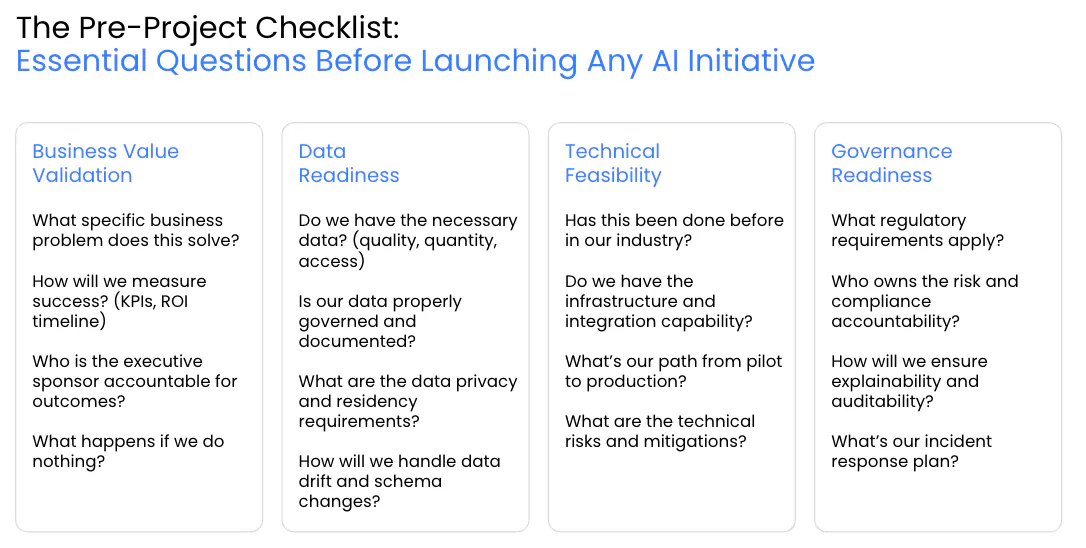
Concealed costs: The hidden factors that make or break AI deployments
Drift monitoring | Continuous monitoring for data drift, concept drift, and performance degradation | Cost: $10K–30K annually per model |
Prompt testing & red-teaming | Regular adversarial testing to identify vulnerabilities, jailbreak attempts, and edge cases before attackers do | Frequency: Weekly, not annually |
Data schema management | Enterprise data evolves constantly. Schema changes break integrations, requiring continuous pipeline maintenance. | Impact: 35% of production issues |
Security reviews | Shift from “twice-a-year SaaS” mindset to “twice-a-week model” reality. AI systems require continuous security validation. | Cost: $20K–80K annually |
MLOps infrastructure | Version control, automated testing, deployment pipelines, and monitoring systems | Cost: $40K–150K annually |
AI/ML operations team | Dedicated team for model maintenance, retraining, incident response, and continuous improvement | Staffing: 3–8 FTEs minimum |
Build or buy? There’s no right answer to the wrong question.
In practice, these 4 dimensions rarely align neatly. A use case might demand speed but carry high regulatory risk. Your team may have the capability to build, but the use case doesn't justify the investment. Those tensions are actually the most useful signal you have. Where the trade-offs are hardest is usually where the strategic decision matters most.
The goal is determining where each approach delivers the greatest advantage for a specific use case. For most organizations, that means evaluating the factors above and deciding which takes priority.
In part 2 of this series, we look more closely at the hybrid model and why more enterprises are using it to move faster while maintaining control.
Start with the right questions
Turing works at the intersection of frontier research and enterprise deployment. Our experience with leading AI labs informs what's realistic, reliable, and ready for production.
That perspective helps enterprises move faster, avoid costly missteps, and deploy AI systems that scale within real regulatory and operational constraints.
Talk to a Turing Strategist about what this looks like for your enterprise.
Build with the world’s leading AI and Engineering talent
Whether you need an agentic workflow, a fine-tuned model, or an entire AI-enabled product, we help you move from strategy to working system.
Realize the value of AI for your enterpriseMohan Pasappulatti is a technology executive who turns AI strategy into growth, margin improvement, and operational performance. He partners with C-suite leaders and leads AI transformations for organizations ready to move from experimentation to enterprise-scale impact. He defines the business strategy, technical roadmap, platform architecture, and aligns cross-functional teams and partners around measurable outcomes — faster growth, higher margins, and durable competitive moats. He has delivered AI and ML solutions across Adtech/Martech, Fintech, Healthcare & Life Sciences, eCommerce, Travel, Media & Entertainment, and Industrial markets, and now focuses on generative AI as the lever that accelerates every one of those outcomes.
Share this post

Want to accelerate and innovate your IT projects?
Talk to one of our solutions experts and make your IT innovation a reality.
Get Started