

Hybrid AI: Why the best enterprise AI programs buy the core and build the edge

Mohan Pasappulatti
•3 min read
- Frontier AI
- Languages & Frameworks

Speed or control? Enterprise AI programs are choosing both
Build or buy? What was once a clear-cut choice is evolving into a more flexible approach, blending the speed of buying with the control of building.
Finding the right balance is where it gets hard. Overbuild, and the organization slows under unnecessary complexity. Overbuy, and you risk outsourcing the capabilities that drive competitive advantage.
The stakes are also higher than they look. As AI becomes embedded in core business processes, these decisions are harder to unwind. Getting it right the first time matters more than it used to.
In part 1 of this series, we covered how enterprises can evaluate buy/build decisions across 4 key dimensions. Here we take a closer look at hybrid AI, the strategy high-performing enterprises are using to stay ahead.
What is a hybrid AI strategy?
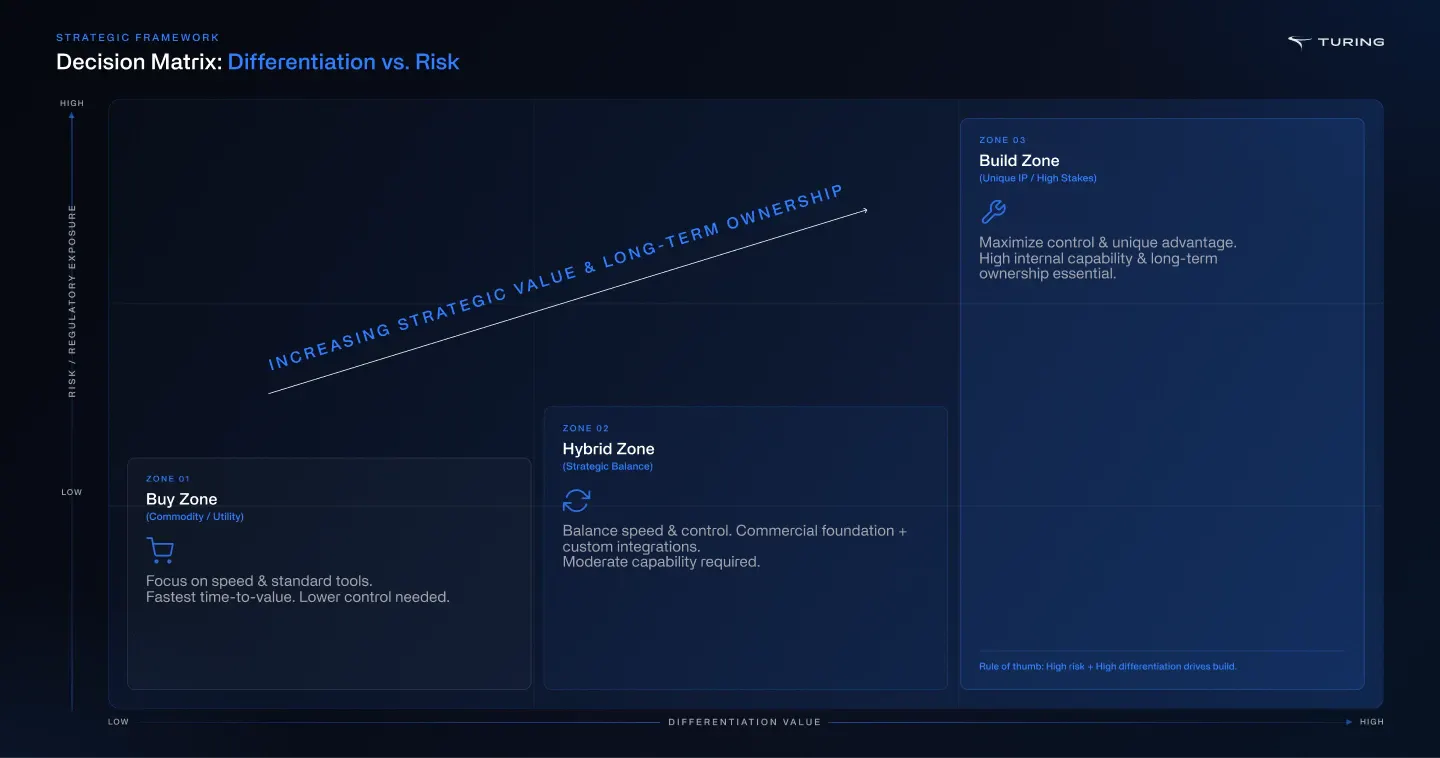
A hybrid AI strategy follows a simple formula: buy what’s standardized, build what differentiates.
The core is where you maintain operations. These are standardized systems already built, scaled, and continuously improved by vendors. Rebuilding them internally consumes time and resources without adding differentiation, and increases complexity and risk.
Building makes sense when value comes from unique data, decision logic, and expertise. AI copilots, agentic workflows, custom integrations, and proprietary intelligence sit on top of the core and should be tailored to your enterprise operations.
Buy the core | Build what differentiates |
Systems of record, compliance-heavy infrastructure, proven workflows, support functions | AI copilots, agentic workflows, custom integrations, proprietary intelligence |
Why hybrid wins
Speed + differentiation: Deploy proven solutions quickly while focusing limited internal resources on the capabilities that set the organization apart.
Risk mitigation: Rely on established platforms for regulated, high-risk components while retaining oversight of critical decision logic and data.
Talent efficiency: Direct scarce AI and engineering talent toward high-value use cases instead of rebuilding commodity capabilities.
Future flexibility: Adapt, swap components, and evolve the AI stack as business needs and technologies change.
What does hybrid AI look like in practice?
Hybrid AI uses a composable architecture where external platforms integrate with internally built capabilities. When designed and implemented well, it behaves as a unified system despite being modular.
Banking: Fraud detection
- Buy: Core transaction monitoring platforms to meet compliance, scalability, and reporting requirements
- Build: Custom ML models that leverage customer data to detect behavioral patterns
Healthcare: Clinical decision support
- Buy: EHR integration platforms to ensure interoperability, security, and regulatory compliance
- Build: Proprietary diagnostic or decision-support models, where control of IP is critical
Insurance: Claims processing
- Buy: Document processing engines to manage OCR and data extraction at scale
- Build: Custom risk scoring and fraud detection models to improve decision quality and maintain a competitive edge
What’s next?
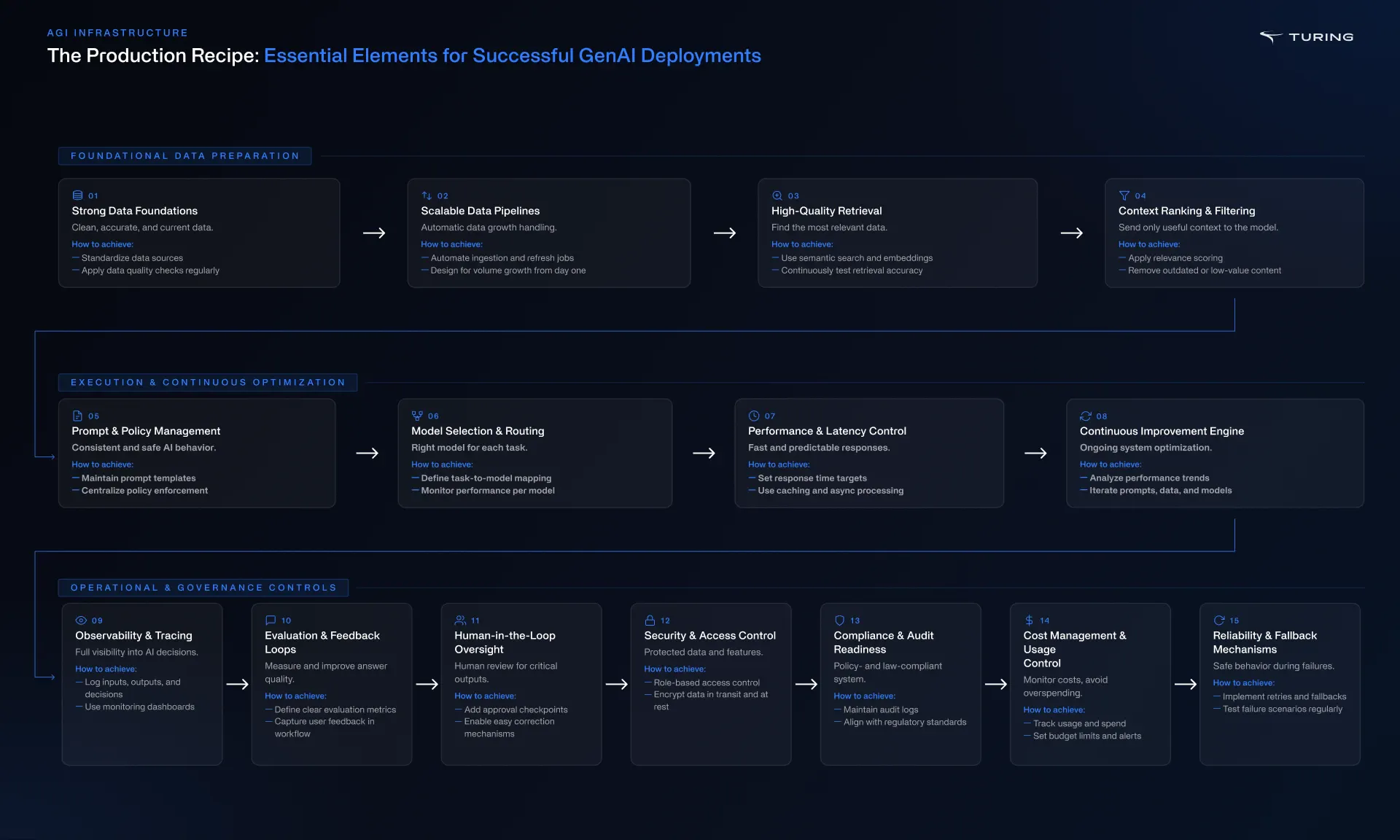
Hybrid AI is typically delivered in phases, starting with core bought capabilities and building toward more differentiated use cases over time.
The following 12-month timeline is a practical guide our experts use with clients to move from initial deployment to long-term value.
Months 1-3 | Months 3-6 | Months 6-12 | Month 12+ |
Buy | Integrate | Build | Scale |
Vendor selection, core platform procurement | Platform integration, data pipeline setup | Custom layer development, differentiation | Production deployment, continuous improvement |
Put hybrid AI to work
The most effective AI strategies design for both speed and control. High-performing enterprises buy what's proven and build what differentiates.
Getting there requires a clear strategy, the right partners, and a realistic plan. Talk to a Turing Strategist to explore what a hybrid AI strategy looks like for your enterprise.
Build with the world’s leading AI and Engineering talent
Whether you need an agentic workflow, a fine-tuned model, or an entire AI-enabled product, we help you move from strategy to working system.
Realize the value of AI for your enterpriseMohan Pasappulatti is a technology executive who turns AI strategy into growth, margin improvement, and operational performance. He partners with C-suite leaders and leads AI transformations for organizations ready to move from experimentation to enterprise-scale impact. He defines the business strategy, technical roadmap, platform architecture, and aligns cross-functional teams and partners around measurable outcomes — faster growth, higher margins, and durable competitive moats. He has delivered AI and ML solutions across Adtech/Martech, Fintech, Healthcare & Life Sciences, eCommerce, Travel, Media & Entertainment, and Industrial markets, and now focuses on generative AI as the lever that accelerates every one of those outcomes.
Share this post

Want to accelerate and innovate your IT projects?
Talk to one of our solutions experts and make your IT innovation a reality.
Get Started