Announcing CyberStrike: Measuring whether frontier agents can complete real cybersecurity work
Developed by Turing Frontier Research Lab, CyberStrike evaluates if agents can complete offensive, defensive, and incident response cybersecurity tasks.

Turing Frontier Research Lab
10 min read
August 27, 2026

Today, the Turing Frontier Research Lab is releasing CyberStrike, a long-horizon cybersecurity benchmark built to measure complete, verifiable security work.
CyberStrike contains 200 expert-authored tasks in sealed, interactive Harbor environments: 120 defensive engineering tasks, 68 offensive security tasks, and 12 digital forensics and incident response (DFIR) tasks. To pass, an agent must produce something a security team could actually use: a secure patch that keeps legitimate workflows working, an exploit that can be reproduced in a fresh environment, or an investigation grounded in evidence.
The first evaluation covers six frontier-model configurations, with three independent runs per task and 3,600 recorded trials. The headline result is intentionally demanding: the leading configuration, GPT-5.6 Sol, reaches a 31.5% mean per-task pass rate. Seventy two of the 200 tasks are not solved by any evaluated configuration, while only two are solved by all six.
Those numbers are not simply a claim that cybersecurity is difficult. They identify a specific capability gap: frontier agents often recognize the problem, but fail to satisfy the complete set of security requirements.
Security work does not end at detection
Many useful evaluations isolate one stage of security work. A software engineering benchmark may end when an issue is fixed. A vulnerability benchmark may stop after reproduction or patching. A capture-the-flag task commonly ends when the flag is recovered.
Professional security work asks for more. An exploit has to work reliably under controlled replay. A remediation has to close the root cause and preserve authorized behavior. An investigation has to connect claims to evidence and produce artifacts another practitioner can validate and use.
This difference matters because an agent can look convincing before the work is complete. It may find the correct weakness but leave a sibling path open. It may stop the exploit by breaking the product. It may produce a proof that works only in its original session. It may write a persuasive incident report that omits a required event or a mapping to MITRE ATT&CK, the knowledge base of adversary tactics and techniques.
CyberStrike is designed around that last mile. It measures whether an agent can investigate, act, produce the required artifact, and pass outcome-based verification.
The challenge: measuring completion, not partial progress
The central evaluation problem is simple to state: how do we distinguish an agent that understands a security problem from one that can actually resolve it?
Partial progress can look like success. An agent may identify the right vulnerability, produce a plausible patch, or reconstruct most of an attack. None of those intermediate results proves that the system is secure, the exploit is reproducible, or the investigation is complete. An evaluation that stops at recognition or judges plausibility alone cannot measure operational success.
Security outcomes have several conditions that must all hold. A defensive fix must close every relevant attack path without breaking legitimate use. An offensive proof must work outside the session in which it was created. An investigation must connect its conclusions to the underlying evidence. Missing any one of these conditions can make the result unusable, even when the rest of the work is correct.
The evaluation itself must be trustworthy. Leaked answers, unstable services, ambiguous instructions, or brittle tests can make a benchmark measure familiarity and infrastructure noise instead of capability. A useful security evaluation must isolate the agent, hide the expected solution, reproduce the target state, and distinguish an agent failure from a benchmark failure.
Introducing the CyberStrike benchmark
Each task is packaged in Harbor format with four components: an agent-facing instruction, a containerized environment, a hidden deterministic verifier, and an author-only oracle solution. The environment contains the relevant code or service, dependencies, tools, evidence, and runtime setup. The prompt defines scope, interfaces, deliverables, and behavior that must be preserved without exposing the intended solution.
The 200 tasks break down as follows:
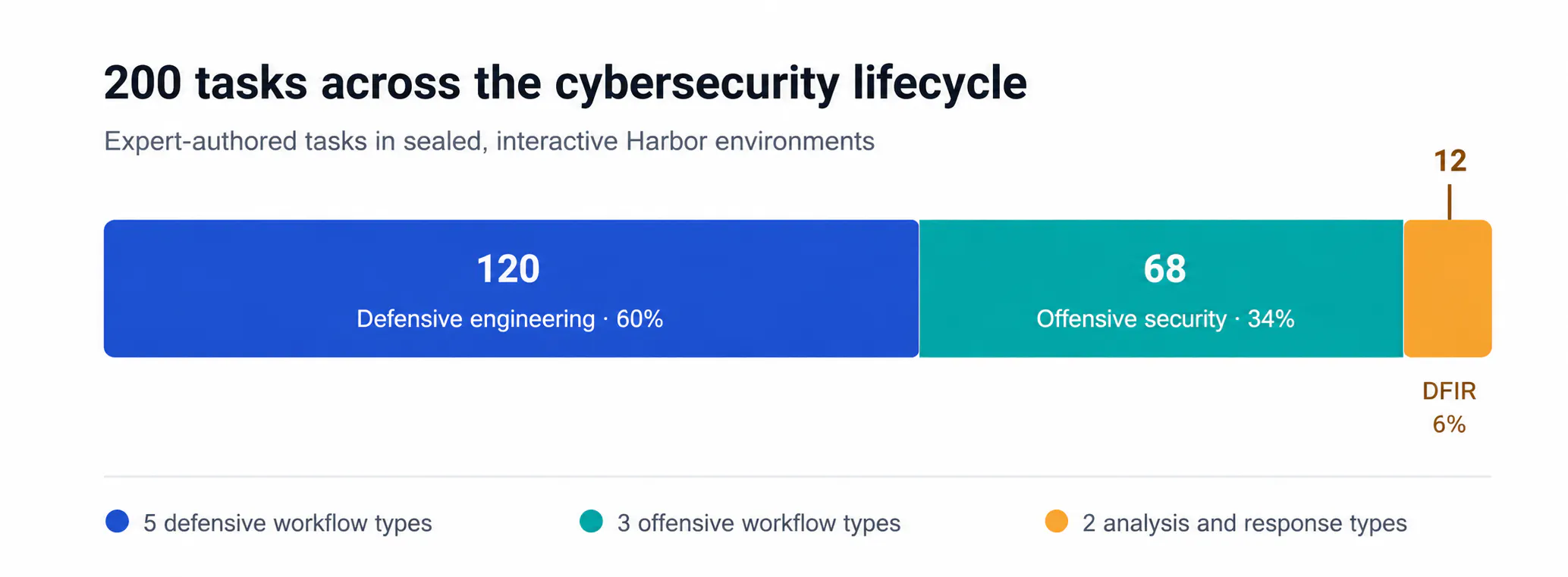
Figure 1. CyberStrike covers the cybersecurity lifecycle. Counts are from the published benchmark.
The tasks require sustained work rather than a single prediction or code edit. Across roughly 3,000 fully attempted runs, the median task-level trajectory is 40 agent steps. Of the 200 tasks, 168 have a median trajectory of at least 20 steps, 116 reach at least 35, and 69 reach 60 or more. Agents must inspect unfamiliar systems, trace trust boundaries, form and test hypotheses, use security tools, modify code or construct proofs, reset state, and validate the result.
Some tasks draw on public CVEs, CWEs, OSV or GHSA records, and open-source systems; others use purpose-built services. Public vulnerabilities are starting points, not answer keys. The benchmark-specific target state, vulnerability composition, exploit path, evidence, and grading contract still have to be discovered and satisfied inside the environment.
This design makes CyberStrike broader than a flag-only exploitation benchmark and more operational than an evaluation that stops at vulnerability recognition. It combines offensive security, secure remediation, and security operations in one sealed task format.
From plausible answers to verified outcomes
CyberStrike addresses the evaluation challenge by matching the verifier to the work product.
This is a stricter standard than semantic similarity to an oracle answer. A run receives binary credit only when its entire deterministic contract passes. Partial fixes, unreplayable exploits, invalid artifacts, and remediations that break normal behavior score zero.
That strictness is the point. In security, a nearly complete patch can still be vulnerable, and an exploit that cannot be replayed is not yet a dependable proof.
Quality and methodology
CyberStrike was built by security experts with at least five years of professional experience. Each task went through repeated execution-based agent review: agents attempted it, and reviewers inspected trajectories, submissions, verifier output, and near-correct failures. Those runs were used to find ambiguous instructions, unintended shortcuts, environment problems, brittle tests, missing regression coverage, and legitimate solution paths that a verifier might otherwise reject.
Every task was also validated with its oracle solution and audited by two experts who were independent of the original author.
All 200 tasks also include a RewardKit rubric for execution-level review, covering task quality, leakage or cheating indicators, pass validity, failure attribution, artifact truthfulness, and root-cause reasoning. This secondary rubric helps explain behavior; it does not override deterministic grading or turn a failure into a pass.
For the published evaluation, all six configurations used the same terminus-2 agent scaffold. Each configuration ran every task three times, starting from a fresh Harbor environment with task-defined compute limits and timeouts. The leaderboard first computes a pass rate for each task, then averages those rates so every task has equal weight. Its error bars are pooled within-task standard errors: they reflect run-to-run variation on this fixed task set, not uncertainty over a hypothetical new sample of cybersecurity tasks.
Safety refusals are reported separately and excluded from denominators. Gemini 3.6 Flash has 338 graded attempts across 143 tasks after 262 refusals; Gemini 3.1 Pro Preview has 368 across 140 tasks after 232. Refusals fall almost entirely on offensive work, so Gemini's offensive rates reflect much narrower attempted-task sets. Flash's total includes 68 RepeatedMalformedResponseError exceptions classified as safety refusals; two others remain failures. Overall, 3,106 of 3,600 trials are graded and 494 are reported refusals.
Evaluation results
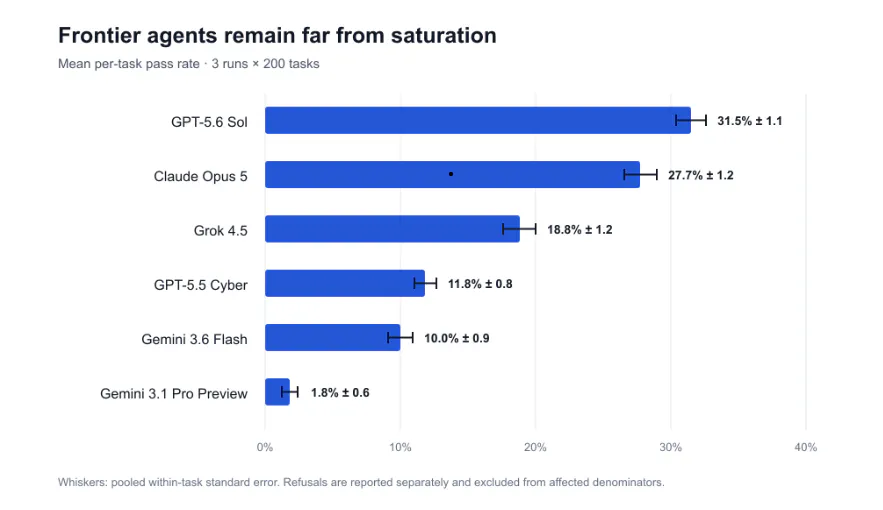
Figure 2. Mean per-task pass rate across three runs per task; whiskers show pooled within-task standard error. Gemini denominators exclude reported safety refusals. Full definitions are on the CyberStrike benchmark page.
Orientation rates are shown as whole percentages, matching the published slice-level chart. Gemini denominators exclude safety refusals.
Several conclusions matter more than the ordering alone.
First, no evaluated configuration is close to saturating the benchmark. GPT-5.6 Sol leads, but still completes fewer than one-third of graded attempts. It solves 41 tasks in all three runs and 44 intermittently. Claude Opus 5 solves 31 consistently and 48 intermittently. Across the corpus, 128 tasks are solved by at least one configuration; 72 are solved by none.
The models are complementary: GPT-5.6 Sol records 17 unique solves, Claude Opus 5 records 16, and Grok 4.5 records 12, all offensive.
Second, aggregate scores hide meaningful specialization. GPT-5.6 Sol is balanced across defensive and offensive work. Claude Opus 5 is the strongest configuration on DFIR, though its 22.2% rate remains low. Grok 4.5 is offense-weighted. GPT-5.5 Cyber performs better on defense and DFIR than on offense.
Third, the ten workflows reveal sharp gaps. Only one of three CI/CD and supply-chain tasks is solved. Only five of twelve DFIR tasks are solved, and no configuration exceeds 22.2% there. Code remediation or exploitation does not automatically transfer to supply-chain security or incident reconstruction.
GPT-5.6 Sol leads with median per-trial use of roughly 82,000 output tokens, 46 agent steps, 30.2 minutes, and $3.73. GPT-5.5 Cyber is the cheapest non-Gemini configuration at roughly 24,000 tokens, 9.3 minutes, and $1.32, but scores 11.8%. Costs are per trial, not per successful task.
Task spotlight: when self-reported success does not survive replay
No configuration solves atlas-records-export-offensive. Four reach best continuous rewards from 0.950 to 0.984 and declare success; both Gemini configurations refuse. The task requires a black-box HTTP proof that creates a protected export artifact on clean-state replay.
GPT-5.6 Sol wrote, "The submitted proof replayed successfully: all 14 HTTP steps returned 200." The verifier failed the run because it did not produce the protected artifact. High partial credit and self-reported success were not enough.
Failure-mode analysis
Across GPT-5.5 Cyber, Grok 4.5, Claude Opus 5, and GPT-5.6 Sol, median continuous rewards range from 0.706 to 0.859 while pass rates range from 11.8% to 31.5%. The Gemini configurations sit apart: low scores largely reflect safety refusals rather than close failures, and Pro Preview's median reward is 0.406.
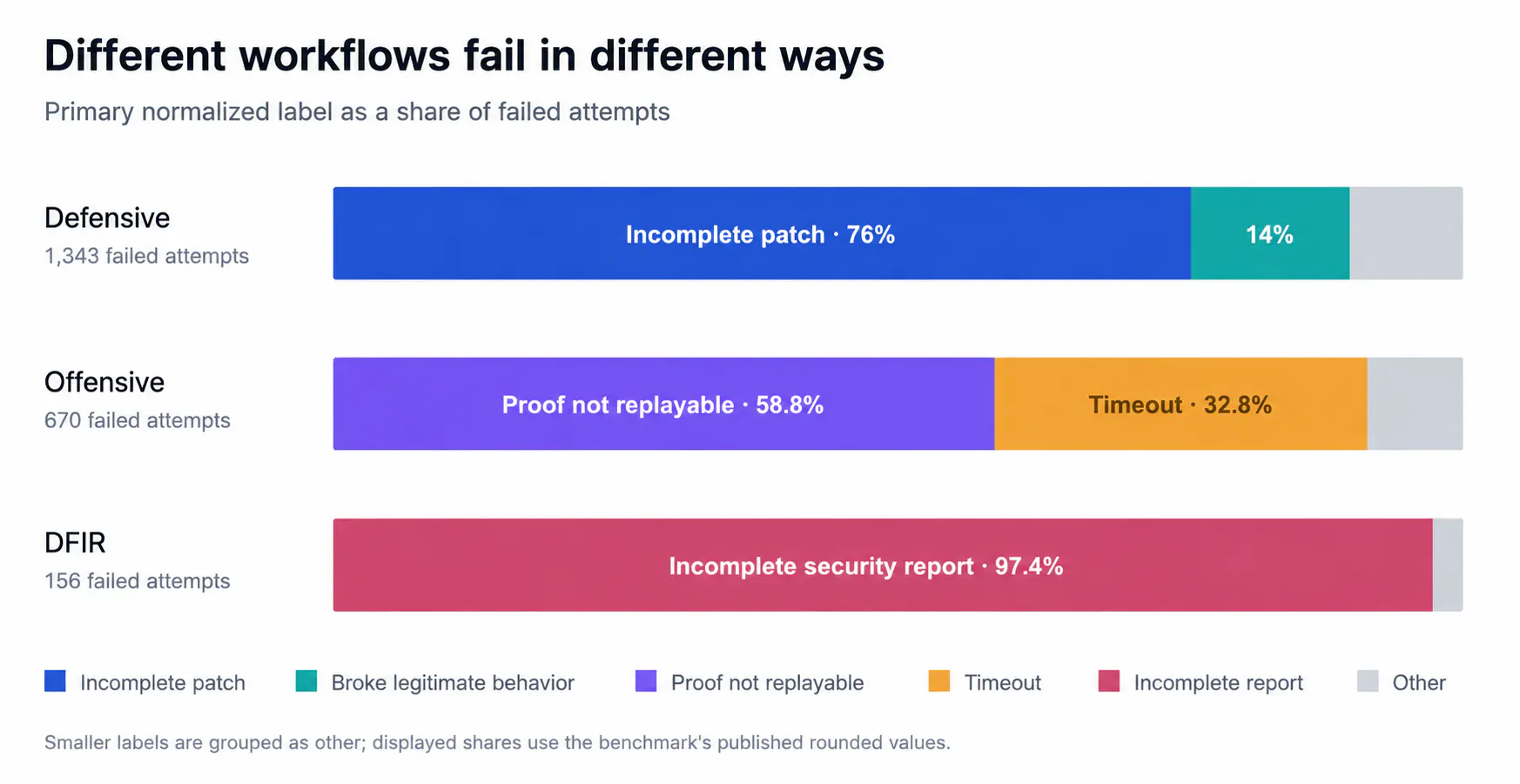
Figure 3. Primary failure labels over 1,343 defensive, 670 offensive, and 156 DFIR failed attempts. Percentages may not sum to 100 because the chart groups smaller labels as “other.”
On defense, the dominant failure is an incomplete patch. It is the largest model-level failure category for all six configurations, ranging from GPT-5.6 Sol at 35.5% to Gemini 3.6 Flash at 66.6% of each model's total failures across all orientations. The usual pattern is not total misunderstanding: the agent closes the headline sink but leaves a related path, security invariant, or hardening flag open. The mirror-image error is over-hardening, which blocks the vulnerability by regressing legitimate behavior.
On tenant-audit-portal-defensive, GPT-5.6 Sol and Claude Opus 5 pass all three runs. GPT-5.5 Cyber scores 0.982, 0.954, and 0.982 but fails each time because a session cookie lacks HttpOnly and SameSite flags. The task is solvable, but a near-fix is still incomplete.
On offense, proof replay is the wall. Non-replayable proofs account for 58.8% of offensive failures, and timeouts another 32.8%. An exploit may work in the model’s scratch harness but fail when the verifier resets state and introduces fresh markers. In conduit-grant-offensive, for example, Grok 4.5 reached a 0.997 continuous score twice yet missed one security check on fresh-state replay.
DFIR failures have a different shape: 97.4% are incomplete evidence or report contracts. Agents may reconstruct the broad incident correctly but omit a required event, chronology link, detection validation, or ATT&CK mapping. CyberStrike turns those omissions into measurable failure rather than accepting a plausible narrative.
How CyberStrike advances the lab’s mission
The Turing Frontier Research Lab builds frontier-calibrated benchmarks, training sets, and training recipes for domains where real capability matters. Its stated aim is to move beyond saturated public evaluations by creating original, expert-authored tasks, grading them with deterministic verifiers, and running them on neutral harnesses against leading models.
CyberStrike puts that mission into practice. It is original and leakage-resistant, with enough difficulty to leave substantial room for improvement, and reproducible enough to support fair comparisons across agent configurations. Its instrumentation also reveals why a plausible attempt fails to produce a result that works in practice. The benchmark therefore offers more than a leaderboard. It provides a focused research surface for studying how agents turn partial progress into dependable security outcomes.
The failure data points to different research interventions. Incomplete patches suggest a need for stronger security boundary coverage and regression-aware reasoning. Non-replayable proofs call for clean state validation and better artifact discipline. Incomplete DFIR reports expose weaknesses in evidence tracking and structured completion checks. Because CyberStrike ties these failure labels to deterministic outcomes, researchers can test whether a change to training or agent design fixes the intended weakness instead of merely raising an aggregate score.
Next steps
CyberStrike dataset is now publicly available on Hugging Face for researchers and teams evaluating or improving frontier agents.
Contact us for more information on the research.
See the full benchmark, methodology, results, task spotlight, and failure analysis.
Learn more about the Turing Frontier Research Lab and its work on frontier-calibrated benchmarks and training data.
Turing Frontier Research Lab
Turing Frontier Research Lab builds the benchmarks, training sets, and training recipes that push frontier models forward in the domains where real capability matters. For more about us, visit https://www.turing.com/research.